The Township has proposed using PILOT money for bathrooms and a concession stand at the high school stadium. No cost has been set, and the Board of Education has not accepted the project.
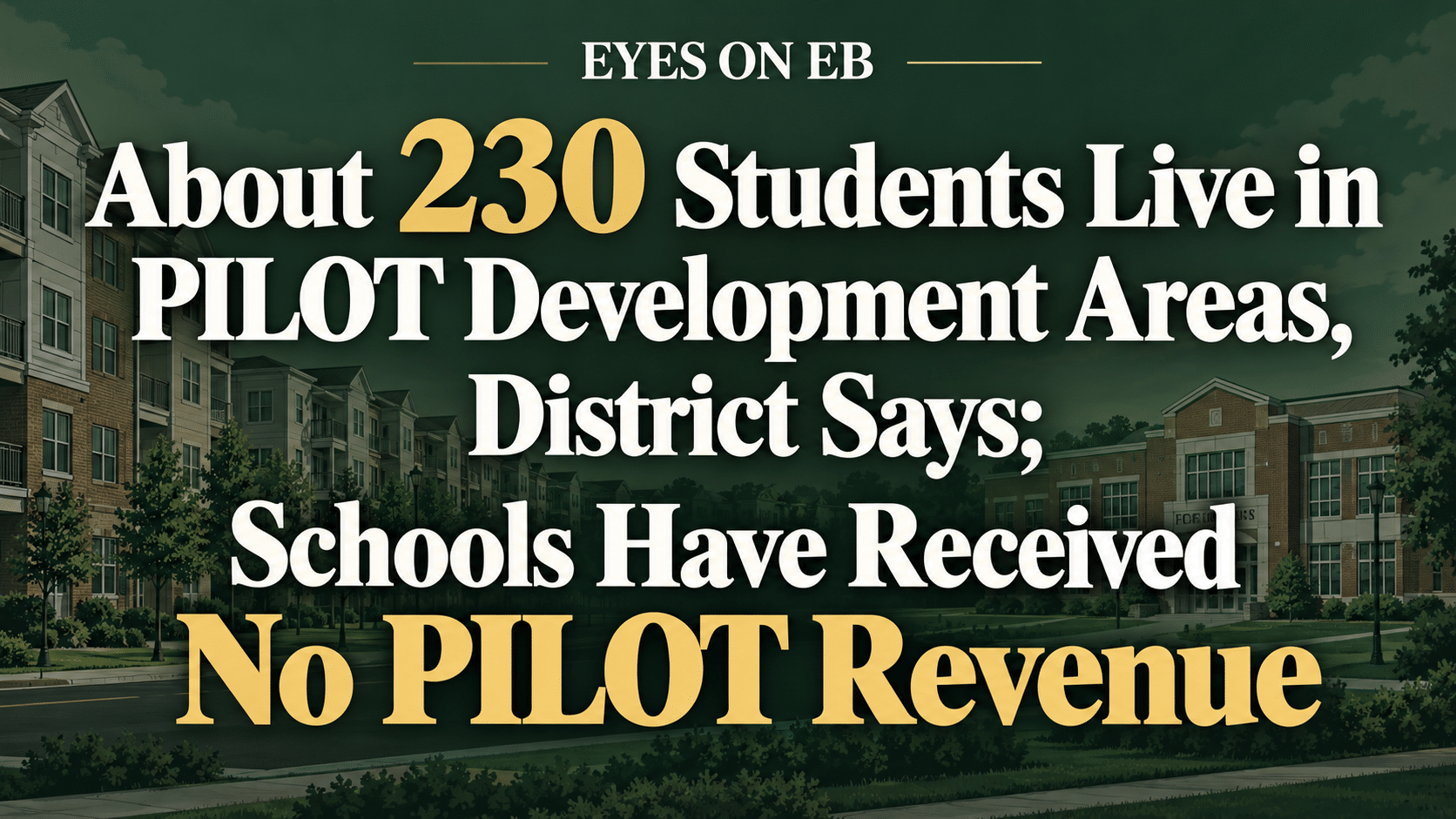
About 230 East Brunswick public school students live in five development areas the district associates with payment in lieu of taxes agreements, school officials told the Board of Education on Oct. 8. The district has received no PILOT revenue from the Township, they said.
The 230 are not all students from properties paying PILOTs. The count includes Vermella and District Walk, which county tax records reviewed by Eyes on EB on Oct. 9 still list as ordinary taxable property with no PILOT exemption. The school district receives its normal share of the taxes billed on them. Developments that do pay PILOTs also still pay regular taxes on their land, as explained below.
In the same discussion, officials said the Township proposed in late spring to use PILOT money for permanent bathrooms and a concession stand at the high school stadium. The idea was the Township’s, no cost has been set, and the Board has not agreed to it, they said.
The student count
Business Administrator Joseph Crotchfelt put the number at “approximately 230,” from “five different areas.”
Officials named two of the five. District Walk, the newest, has one student, with another family registering that day. Vermella has six, up one since the Board’s previous meeting. The other three areas were not named, and no breakdown was given.
The count measures where students live, not how many are new to the district. It is also not directly comparable to earlier figures. At the Sept. 24 meeting, Crotchfelt gave partial counts for Kensington and Legacy Place that the recording does not capture clearly enough to report. The district’s annual financial report, dated Jan. 15, 2026, said occupied units at Legacy Place had resulted in 86 students enrolled at that time.
What ‘no PILOT revenue’ means
Asked directly whether the district has received “any PILOT funds whatsoever,” two officials answered, “No.”
That refers to the PILOT payment itself, called an annual service charge, which a developer pays the Township instead of conventional taxes on the buildings. State law sends 5 percent of it to the county; the Township keeps the rest. The school district receives no direct share.
The land is treated differently. Under the agreements Eyes on EB has reviewed, the land under a PILOT development is still taxed in the ordinary way, and the school district receives its normal share. Eyes on EB has calculated that school share at roughly $57,000 for Kensington Place in 2025 and roughly $52,000 for Legacy Place in 2026, far less than a school share of a conventional tax bill on the whole property, because land is a small part of these properties’ value.
Vermella and District Walk have PILOT agreements, but Township budget records show no PILOT payments from them through 2025. County tax board records viewed Oct. 9 list every Vermella and District Walk parcel as taxable, with 2026 taxes billed on the District Walk land and no exemption record. Those records still show the District Walk land as “future townhouse” lots and do not yet list individual completed homes, so Eyes on EB could not confirm how homes now occupied there are being billed.
The stadium proposal
“We were not going to say no to building,” Superintendent Dr. Evelyn Mamman said. “So we said, ‘Let’s see what you come up with.'” The Township did not offer a sum and ask what the district needed, she said. “It was, this is what we want to do.”
Asked by Board member Antoinette Evola what made the project an option, an official answered, “They approached us. It was their idea.” That was in “May, late May, June,” officials said.
Crotchfelt said he asked whether new lighting could be added “because we have some dark spots,” but “we as the district did not commit to anything.” Any project on district property would have to go to the Board, “and that has not happened.”
The cost is “to be determined,” officials said. Crotchfelt said the Township would design and build it “with no financial impact to us,” and that a Township representative has since walked the site with district staff and the athletic director, because bathrooms require pump stations and sewer lines, so the Township could continue its design.
Asked whether the project is a priority, an administrator said, “It would be great to get rid of the porta potties and have actual bathrooms,” but noted the district has “a billion dollars worth of capital projects.”
Township officials have described the process differently. At the Sept. 28 Council meeting, Council President Dana Zimbicki said the Township worked with the Board “to see what their wish list would be,” and that stadium bathrooms came out of that. Mayor Brad Cohen said the Township asked the district “last year and again this year” what it would like PILOT money put toward.
Warnsdorfer: conflicting accounts
At the May 11 Council meeting, a Council member said that “as per what the municipality is allowed to do with the pilot money,” the Township “paid for a parking lot at $275,000” at Warnsdorfer Elementary School, at no cost to the Board. Cohen listed the repaving among the Township’s contributions to the schools in his Feb. 25 State of the Township address. On Sept. 28, Zimbicki said of about $1.6 million in additional PILOT money, “With that $1.6 million, we did work with the Board of Ed to do some parking lot pavement.”
On Oct. 8, Board member Liwu Hong asked whether the repaving was PILOT money. “It was not a pilot,” Crotchfelt said, explaining that the Township had money left on its paving contract after finishing its own projects.
The funding source remains unresolved. PILOT payments go into the Township’s general operating fund with other revenue, and Eyes on EB has not found a Township appropriation or resolution identifying how the Warnsdorfer work was paid for.
What state law says
A community question asked whether PILOT money given to the district could support operating costs or only capital projects. “I think the answer is yes to both,” a district administrator answered, though one time money is better spent on construction than on recurring costs. A Board member said some towns give their schools a yearly percentage of PILOT revenue, and officials named Cedar Grove as having a flat dollar arrangement. Eyes on EB has not reviewed those towns’ agreements.
Two state laws bear on the question, and they do different things.
The Long Term Tax Exemption Law, N.J.S.A. 40A:20-12, governs the PILOT payment. It requires 5 percent for the county and mentions school boards in one situation only: a contract under N.J.S.A. 18A:7G-15.1a. That law, amended in 2024, lets a school board issue bonds for a state approved construction project without a public vote if a town agrees in writing to send it enough PILOT revenue from designated properties to cover the debt payments. It applies only to construction debt. Eyes on EB has found no record that East Brunswick has used it.
The second, N.J.S.A. 40:48-17.1, is about municipal surplus, not PILOTs. The 1941 law allows a town whose borders match its school district’s, as East Brunswick’s do, to transfer “unappropriated surplus revenue or unappropriated anticipated receipts” to its board of education by resolution, if the transfer is in the adopted municipal budget. Its text places no limit on how the board uses the money and does not mention PILOT revenue. Eyes on EB has found no state guidance or court decision on whether a town may use it for a recurring share tied to PILOTs, or how such a transfer would count under state budget caps. Those questions remain open. The Township’s 2026 budget includes no transfer to the Board.
Township officials have said the limit is capital only. In February, Cohen said PILOT money given to the schools “can only be done for capital projects,” and on May 11 a Council member said “it has to be a capital improvement under the law.” Eyes on EB has not found that limit in the text of either statute or identified the source officials rely on.
A state bill, S1807, would require towns to share PILOT revenue with school districts. It has been in the Senate Budget and Appropriations Committee since Feb. 5.
No ordinance, resolution or contract on the record shares a set amount or percentage of PILOT revenue with the schools, and no one at the Oct. 8 meeting said one has been proposed.
The $4.5 million figure
After the count was given, a Board member multiplied it by about $20,000 per student, described as the district’s rate “give or take depending on what grade,” and said, “really we’re starting our budget with minus $4.5 million.” At exactly $20,000, 230 students would be $4.6 million. Crotchfelt called it “a way to look at it” but said “it gets a little bit complicated.”
The figure is an illustration based on an average cost per student. It is not a measured deficit, the added cost of these particular students, or property taxes the schools did not receive.
A candidate’s proposal
During public comment, Township Council candidate Vincent Le Blon said he and his running mates, Girish Vazirani and Mina Abdo, “disagree with the exclusion of any significant sharing of the pilot money with the Board of Education.” He said the Township ended 2025 with about $40 million that could have reduced the school tax increase.
The Township’s 2025 audit shows a surplus of $40,000,905 at the end of 2025. The adopted 2026 budget uses $8,553,000 of it, leaving about $31.4 million. Whether any should go to the schools is a decision for the Council, and under the 1941 law it would have to be written into the municipal budget.
What comes next
The district did not say which five areas make up the 230 or how many students come from each. The stadium project has no cost estimate and no Board vote. At adjournment, the Board said it would meet again in two weeks.