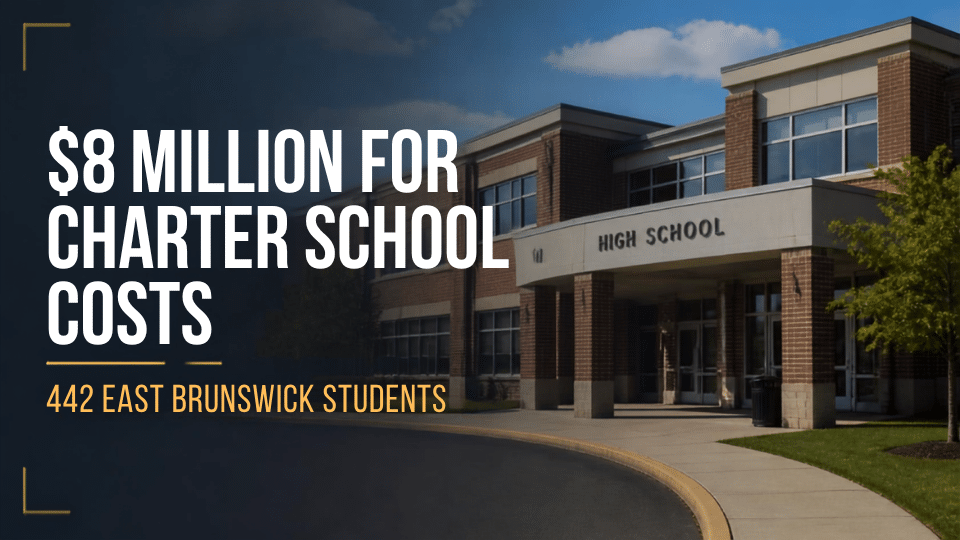
EAST BRUNSWICK, NJ — East Brunswick’s school district has budgeted $8,015,169 for charter school costs in the 2026-27 school year, for a projected 442 students who live in the township but attend charter schools rather than district ones.
That is $966,246 more than the year before — an increase of nearly a million dollars in twelve months.
The figures come from the district’s own budget presentation to the Board of Education on March 19, recorded in the official minutes. They break down into two parts: $7,462,691 in tuition payments the district must send to charter schools, and $552,478 to transport students to them. In the prior year those figures were $6,502,497 and $546,426.
Almost the entire increase is on the tuition side. Transportation rose just $6,052.
Where the students are
Six charter schools enroll East Brunswick students. One of them accounts for nearly all of them.
Hatikvah International Academy, a K-8 dual-language charter school on Lexington Avenue in East Brunswick, is projected to enroll 435 East Brunswick students in 2026-27 — 435 of the 442. The district’s projected payment to Hatikvah is $7,240,095.
The remaining seven students are spread across five schools: two at Thomas Edison EnergySmart, two at Greater Brunswick, and one each at Central Jersey College Prep, North Star Academy and Team Academy.
Hatikvah is a public school. It teaches in English and Modern Hebrew, it is open to any student by application, and East Brunswick residents hold a state-approved priority for its seats. Families who send children there are choosing among public options available to them.
Why the number went up
The increase tracks enrollment. Hatikvah’s East Brunswick enrollment was 393 in the prior year and is projected at 435 — an increase of 42 students, and $924,512 of the district’s added cost. A footnote on the district’s own slide records that by March 12 the figure had already reached 398.
The other schools moved the other way, slightly. Central Jersey College Prep went from three East Brunswick students to one, Thomas Edison from three to two, Greater Brunswick from three to two. North Star Academy and Team Academy each picked up one where they previously had none.
Net, the district’s charter enrollment is projected to rise from 402 students to 442.
What the district actually controls
Very little of this is a local decision.
Under New Jersey’s Charter School Program Act, a school district must pay a charter school for every district resident who enrolls there. The core payment is 90 percent of a per-pupil figure built from the district’s own numbers — its state equalization aid per pupil, its prior-year local tax levy per pupil adjusted for inflation, and a per-pupil share of the employer payroll tax the district receives.
On top of that 90 percent, the district also owes security funding attributable to the student, a proportional share of its special education funding, preschool funding where it applies, and any federal money attached to the student. Transportation is a separate obligation again.
The 90 percent figure exists because a district’s costs do not fall neatly when a handful of students leave. A building still has to be heated, cleaned and staffed.
What matters is what the board cannot do. It does not set the rate. It does not vote on whether to pay. It cannot cap how many East Brunswick children enroll in a charter school. Charter schools in New Jersey are approved and renewed by the state Commissioner of Education, not by the local board. When enrollment counts change mid-year, state rules require the district to spread the adjustment across its remaining payments.
There is one narrow exception. When a student enrolls in a charter school in their first year after attending a nonpublic school, the state pays that charter directly rather than billing the district.
The comparison worth understanding
East Brunswick’s state aid rose this year, from $37,350,708 to $39,591,750 — an increase of $2,241,042.
Charter tuition rose $960,194 over the same period.
Put those side by side: the increase in what the district owes charter schools equals about 43 percent of the increase in what the state gave it. That is a comparison between two changes in the same budget. The state did not earmark any portion of the aid for charter payments, and the money is not tagged or segregated. But in practical terms, a large share of what looked like a $2.2 million improvement was committed before the district could spend it.
Nor is this money the district would otherwise simply keep. These are public school students. If they attended East Brunswick schools, the district would be teaching them and spending on them. The payment follows the student to the public school the family chose.
Why it lands on the tax bill
Charter costs are one line in a budget under real pressure this year. Health insurance premiums rose 22 percent, adding $7,934,618. Out-of-district special education placements added roughly $2 million. Transportation overall rose about $973,000. The district faced a projected shortfall of about $5.6 million, and the school tax levy rose 6.16 percent — roughly $641 a year on a home assessed at $132,000.
Charter payments are not the largest of those pressures. They are, however, among the few the district has no ability to negotiate, reduce or defer.
One caveat
Every figure here is a projection made in March. New Jersey recalculates charter payments after an official enrollment count on October 15, and the state issues revised payment schedules afterward. The final numbers will not be settled until then, and could move in either direction.