Across New Jersey and around the country, school districts have been adjusting their staffing levels in response to changing student needs, operational demands, and shifting enrollment patterns. A national workforce data tool known as WANDA, developed by the Edunomics Lab, provides a clearer picture of how staffing has changed over time in individual districts.
Looking at the data between the 2018–2019 and 2024–2025 school years reveals some interesting trends across Central New Jersey, including in the East Brunswick Township School District and several neighboring districts.
While each community is unique, the numbers show that many districts in the region have increased staffing levels during a period when enrollment has remained flat or declined slightly.

East Brunswick’s Staffing Changes
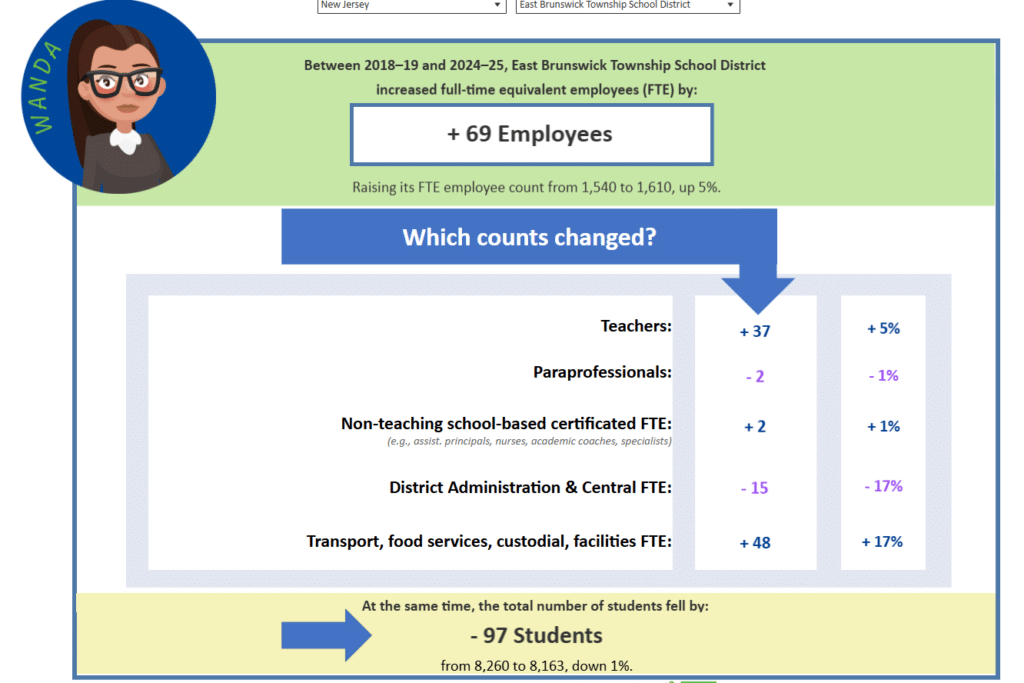
According to the WANDA data tool, the East Brunswick school district increased its total number of full-time equivalent employees by 69 positions between the 2018–2019 and 2024–2025 school years. This represents about a 5 percent increase, bringing the district’s staffing from approximately 1,540 employees to about 1,610.
During the same period, student enrollment in the district declined slightly by 97 students, a decrease of about 1 percent.
Breaking down the staffing changes shows where those increases occurred:
-
Teachers: +37
-
Paraprofessionals: -2
-
Non-teaching certified staff (such as nurses or specialists): +2
-
District administration and central office: -15
-
Transportation, food service, custodial, and facilities: +48
One notable detail in the data is that district-level administrative staffing actually declined over this period, while the largest growth occurred in operations roles such as transportation, facilities, and food services.
How Nearby Districts Compare
East Brunswick is not alone in experiencing staffing changes during this period. Several nearby districts show similar patterns over the same timeframe.
In the South Brunswick School District, staffing increased by 148 employees, a 12 percent increase, while enrollment declined by 930 students, or about 11 percent.
The Old Bridge Township Public Schools took a different approach. That district reduced staffing by 39 employees, or about 3 percent, while enrollment declined by 415 students during the same period.
In the East Windsor Regional School District, staffing increased by 101 employees (about 12 percent) while enrollment declined slightly by 94 students.
The North Brunswick Township Schools also saw staffing growth, adding 108 employees (about 11 percent) while enrollment declined modestly by 57 students.
Meanwhile, the Sayreville Public Schools added 104 employees, about an 11 percent increase, while student enrollment actually grew by 178 students over the same period.
A Regional Pattern
When looking at the six districts together, several trends become clear.
Most districts in the region increased staffing levels between 2019 and today. At the same time, enrollment declined in four of the six districts examined, remained nearly flat in one, and increased in one.
Another interesting pattern is that staffing growth is not primarily occurring in central administration. In many districts, increases appear in areas such as:
-
classroom teachers
-
transportation services
-
custodial and facilities staff
-
food services
-
student support roles
These operational and support positions often expand as districts respond to new service needs, changing student programs, building maintenance demands, or transportation requirements.
Questions Worth Discussing
Data like this raises important questions for communities throughout the region.
What factors are driving staffing increases in some districts even as enrollment shifts? Are districts expanding student services, responding to operational demands, or adjusting staffing to meet new educational or regulatory requirements?
And how should communities evaluate these changes as they plan future budgets and educational priorities?
The WANDA workforce tool offers a helpful starting point for examining these trends. For residents interested in understanding how school staffing has evolved in their communities, the data provides a clearer look at how districts are allocating their workforce over time.