One thing I’ve noticed over time is that not all conversations are built the same.
Some happen out in the open, where anyone can see them, respond to them, and challenge them. Others happen in more controlled spaces, where access is limited and the tone of the conversation is shaped before it even begins.
Both exist for a reason.
What a Bridge Actually Means
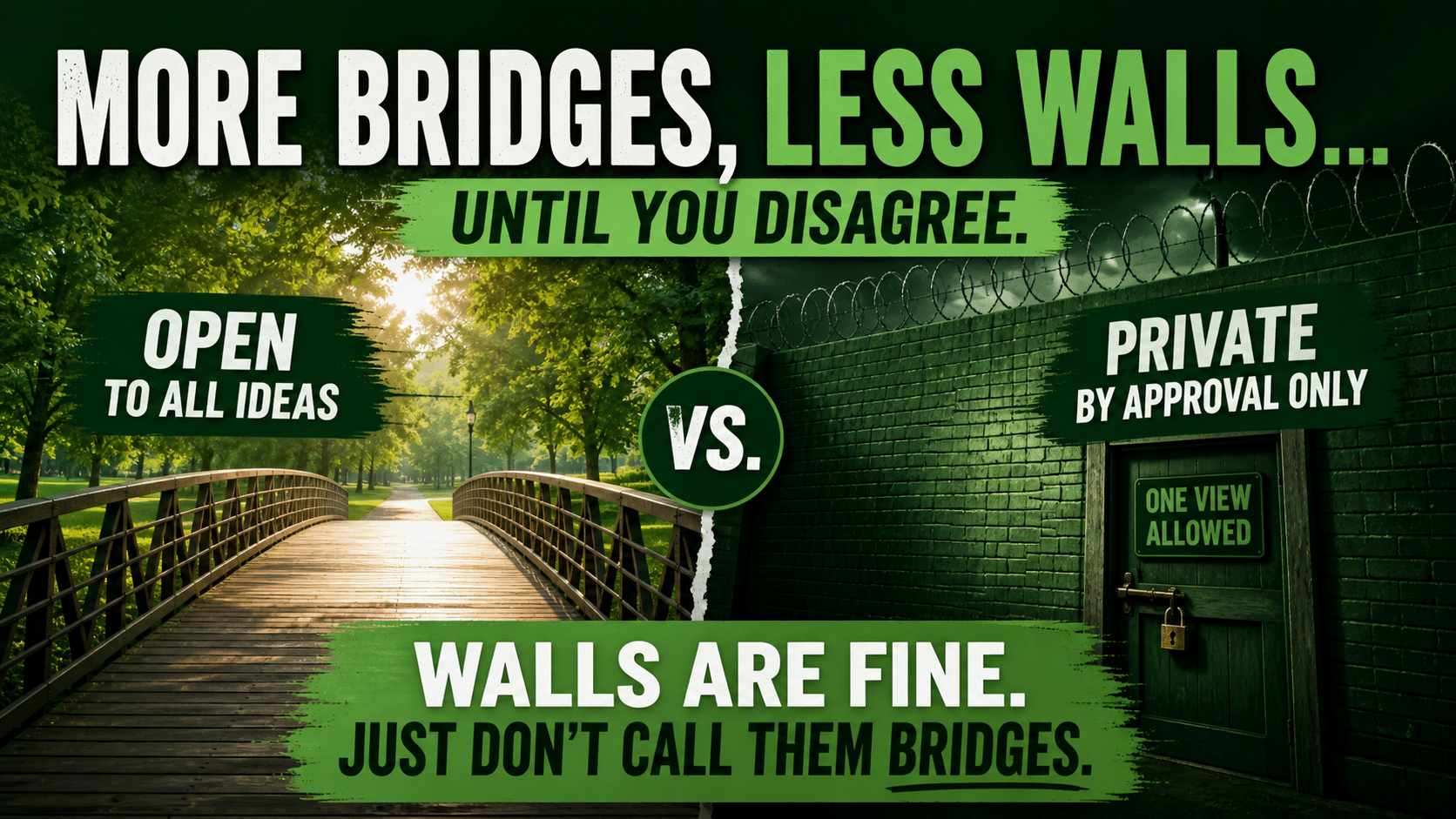
People often talk about building more bridges and fewer walls.
And it’s a great idea—until it becomes inconvenient.
A real bridge doesn’t just connect people who already agree. It brings in different perspectives—different backgrounds, different experiences, and just as important, different ways of thinking.
Because if everyone crossing the bridge already sees things the same way, it’s not really connecting anything new.
When Conversations Become One-Sided
From time to time, I get screenshots from inside private groups. And what stands out isn’t disagreement—it’s how little of it there is.
In some cases, the conversation shifts from ideas to individuals. People get discussed or criticized without being present to respond or defend themselves. That changes the dynamic.
Without anyone in the room to challenge what’s being said, the conversation builds in one direction.
The Wall Effect
There’s nothing wrong with creating a private space. People do it for a reason.
But when a space filters out disagreement, it can start to function less like a bridge and more like a wall.
A bridge invites different perspectives in.
A wall keeps certain perspectives out.
And when that wall is in place, it becomes easier for conversations to turn one-sided without being questioned. Ideas don’t have to be tested the same way. They can be reinforced without much pushback.
What makes it more interesting is that, at times, the same people talking about building more bridges are part of spaces with the highest walls.
It’s often noticeable that people are more outspoken in private spaces where there’s a sense of alignment, and a bit more measured in public.
Keep It Real
If the goal is to build bridges, then the conversation has to include people who think differently—not just people who agree.
Otherwise, it’s not really a bridge. It just looks like one from the outside.