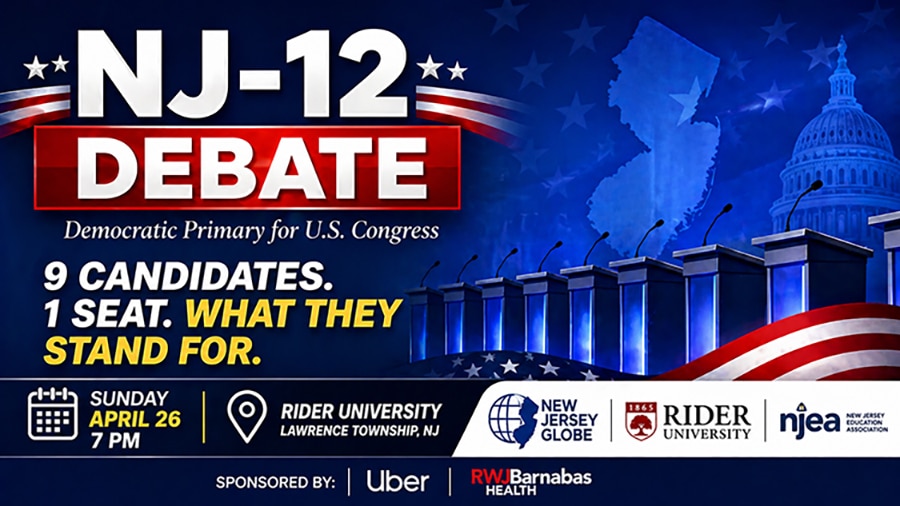
On Sunday night, nine Democratic candidates took the stage at Rider University for the New Jersey 12th Congressional primary debate — a race that will likely determine the next member of Congress in a heavily Democratic district.
Hosted by the New Jersey Globe, the debate brought together a wide range of candidates — from mayors and lawmakers to first-time contenders — each trying to stand out in a crowded field.
For East Brunswick residents, the focus naturally turns to Mayor Brad Cohen — and in a night where many candidates shared similar talking points, he often differentiated himself not just in tone, but in how he approached the issues, particularly when it came to execution, governance, and some of the debate’s more sensitive topics.
A Crowded Stage, Two Clear Lanes
With nine candidates and limited time, the debate moved quickly. Many answers leaned into familiar themes — opposition to Trump, calls to “fight,” and broad policy positions.
But underneath that, a clearer divide emerged.
Some candidates leaned heavily into bold, structural change — abolishing agencies, sweeping reforms, and more aggressive national positions.
Others, including Cohen at times, focused more on governance — how policies actually get passed, implemented, and sustained.
That contrast defined much of the night.
Cohen’s Approach: Less Rhetoric, More Execution
Cohen didn’t try to dominate the debate, but when he spoke, his message was consistent: results matter.
He pulled from his experience as:
- An OB-GYN physician
- A former Board of Education member
- Mayor of East Brunswick
Instead of staying in the abstract, he kept bringing things back to what voters actually see.
At one point, he summed it up directly:
“People get to Congress and spend more time trying to make the other side look bad than actually getting anything done.”
That line captured his lane — less about messaging, more about delivery.
Where He Differentiated Himself
Delivering vs. Debating
While several candidates focused on big, sweeping changes, Cohen consistently redirected toward practicality:
- Can it pass?
- Can it be implemented?
- Will it actually produce results?
It wasn’t the loudest approach — but it was one of the more grounded ones.
Foreign Policy — Not a One-Sided Divide
The Israel discussion created some of the sharpest moments of the night — but it wasn’t as one-sided as it might seem.
While a few candidates pushed for cutting off aid entirely, others — including Cohen — took a more traditional Democratic position:
- Support for Israel’s right to exist and defend itself
- Willingness to criticize leadership decisions, including Netanyahu
Importantly, Cohen wasn’t alone in avoiding the most hardline stance.
Several candidates landed somewhere in the middle — supporting:
- Conditional aid rather than a full cutoff
- A two-state solution
- A balance between humanitarian concerns and long-standing alliances
In other words, this wasn’t a lone position — it was one side of a broader divide within the field.
Immigration — Similar Split
The same pattern showed up on immigration.
Some candidates called for abolishing ICE entirely.
Others — including Adrian Mapp — pushed back, arguing for reform instead of elimination.
Cohen aligned more with that group:
- Acknowledging the system is broken
- Emphasizing legislative reform
- Pointing to bipartisan efforts that failed due to politics
Again, he wasn’t an outlier — but part of a smaller, more moderate lane within the debate.
Healthcare — Where Experience Showed
On healthcare, there was broad agreement: the system isn’t working.
What separated Cohen was how he talked about it — through direct experience dealing with insurance companies as a physician and managing budgets at the local level.
It gave his answers a level of real-world grounding that stood out.
Not Just Cohen — Others Had Strong Moments
To be fair, Cohen wasn’t the only candidate taking a more measured or practical tone.
- Adrian Mapp stood out by pushing back on calls to abolish ICE, instead arguing for reform, emphasizing that systems should be fixed rather than eliminated and focusing on practical governance over sweeping changes.
- Sam Wang brought a more analytical, systems-focused approach, often stepping back to talk about structure, long-term governance, and how institutions like Congress and the courts actually function.
- Squire Servance emphasized affordability and results, focusing on lowering costs and expanding access to healthcare, positioning himself in a more practical, outcomes-driven lane similar to Cohen at times.
- Sue Altman brought a more activist-driven approach, emphasizing systemic change, stronger government intervention, and aggressive stances on issues like immigration and economic reform.
- Jay Vaingankar brought a more activist and an aggressive and direct style, frequently challenging other candidates on stage while pushing for sweeping changes on issues like immigration, energy, and foreign policy.
-
Adam Hamawy leaned heavily on his experience as a combat surgeon and physician, framing healthcare and foreign policy through real-world impact while advocating for broader systemic changes. He also had more of an activist tone.
What This Race Is Really About
If this debate made anything clear, it’s this:
This race isn’t just about policy — it’s about what kind of Democrat voters want right now.
- A more aggressive, change-driven approach?
- Or a more pragmatic, execution-focused one?
That same spectrum exists beyond this race:
- Bonnie Watson Coleman has generally aligned more with the progressive wing
- Phil Murphy operates in a pragmatic-progressive middle
- Mikie Sherrill is often viewed as more moderate
Cohen’s positioning in this debate placed him closer to that Murphy/Sherrill lane — focused on governing, not just messaging.
What It Means for East Brunswick
For a local audience, the takeaway is straightforward:
Cohen didn’t try to be the loudest voice on stage — but he consistently presented himself as someone already doing the work of governing.
For some voters, that’s exactly what they’re looking for.
For others, the moment may call for something more aggressive.
Either way, in a crowded field with competing visions, Cohen carved out a lane that felt distinctly his own — and made it clear where he fits in the broader direction of the party.
Watch the full debate here.