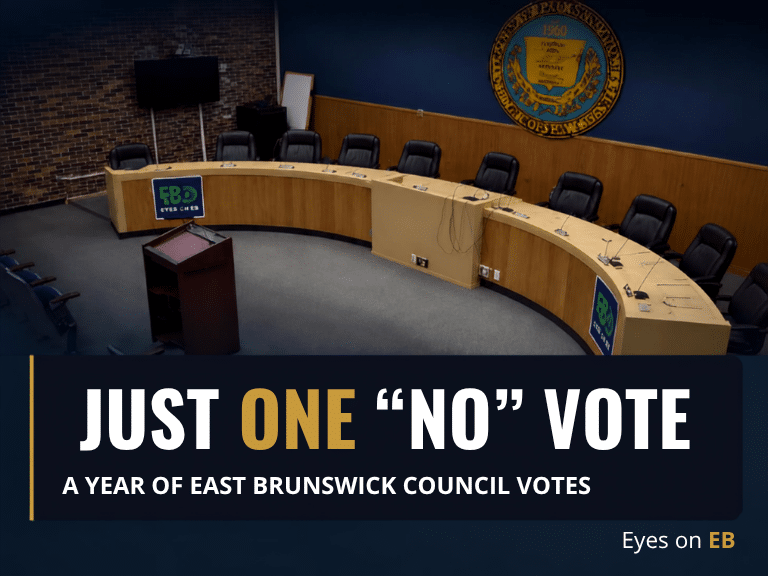
Eyes on EB reviewed every recorded vote the Township Council took over twelve months.
Across 25 East Brunswick Township Council meetings from Aug. 25, 2025 through Aug. 24, 2026, Eyes on EB identified 118 roll-call votes carrying a recorded vote mark in the official minutes. In those 118 votes, council members cast exactly one “No.”
That number is easy to over-read, so three things about it up front.
A single roll call is not a single decision. Much of what the Council enacts moves through a consent agenda, where one motion adopts a numbered range of resolutions at once: 22 such motions carried 337 resolutions during the year.
Not every departure from unanimity is a vote against something. Eleven recorded votes were not unanimous, but ten involved a member abstaining rather than opposing. An abstention is not a No.
And agreement says nothing by itself about whether a proposal was examined closely. A roll call records only where members landed when their names were called.
What the numbers show
This review counts each RECORDED VOTE OF COUNCIL table as one vote, and treats a vote as unanimous when every member who cast a Yes, No or Abstain voted Yes. On that basis, 107 of the 118 votes were unanimous — 90.7 percent.
Removing consent motions barely moves it: of the 96 non-consent roll calls, 85 were unanimous, or 88.5 percent.
Narrowing to substantive business — ordinances at either reading, resolutions set down for a separate vote, resolutions pulled off consent, and add-on resolutions — 61 of 68 were unanimous: 89.7 percent.
All 22 consent motions passed unanimously.
The one No vote
Councilman James Wendell cast the year’s only recorded No vote on July 27, 2026, against Ordinance 26-21, which would designate data centers a prohibited use in every commercial, business and industrial zoning district in the township. It was introduced 4–1.
The minutes record his reason: “Councilman Wendell expressed opposition and concerns to the ordinance. He stated that the definition of a data center is too general and needs to be refined.”
What followed is part of the same story. The hearing, first set for Aug. 10, was rescheduled to Aug. 24, and at that meeting Council President Dana Zimbicki moved from the floor to amend the definition — changing “primary use” to “principal use” to match the township’s land use code, and calling the original wording an error in the printed agenda. The amendment carried. Nobody from the public spoke. The amended ordinance was adopted 4–0, with Wendell voting yes and Council Vice President Dinesh Behal absent.
An objection was raised on the record, the language changed, and the member who objected voted for the result.
The other ten
The remaining non-unanimous votes were abstentions, and they are not evenly spread.
Zimbicki accounts for five, all on one subject: the ordinance fixing compensation for temporary, part-time and seasonal employees. She abstained at every stage — Ordinance 25-42 at its introduction on Nov. 10, 2025 and its second readings on Nov. 24 and Dec. 8, then the successor ordinance 26-02 at its introduction on Jan. 26, 2026 and its adoption on Feb. 9. Councilwoman Dana Winston recorded four abstentions and Behal one.
The minutes state no reason for any abstention in the period, and Eyes on EB is not supplying one. One plausible explanation — that a member abstained on minutes of a meeting they had missed — fits some but not others: Winston was present on Nov. 10 and abstained on adopting those minutes, and Behal was present on Dec. 8 and abstained on adopting those.
Ordinance 25-42 also produced the year’s only failed ordinance, though not because the Council rejected it. On Nov. 24, with Wendell and Winston absent and Zimbicki abstaining, it drew two yes votes and the minutes state it “was NOT adopted on second reading.” A New Jersey ordinance needs a majority of the full governing body, and two of five is not one. Fourteen days later, with all five present and Zimbicki again abstaining, it was adopted 4–0 — a difference of attendance, not of position.
The conflict rules are visible too. Winston recused herself from two ice arena concession resolutions on Dec. 22, 2025, and she and Behal both recused themselves from the award of that contract on Feb. 9, 2026, when Wendell disclosed that his son had previously worked for one of the bidders. The minutes place recused members in the “Absent” column rather than “Abstain,” so recusals appear nowhere in the vote tables.
What a consent agenda is
The consent agenda accounts for most of the Council’s output. It is a standard municipal device, not an East Brunswick invention: items considered routine are grouped and adopted by one motion. The agenda says they “are considered routine and non-controversial,” with no separate discussion “unless a Council Member so requests.”
During the year 337 resolutions moved through 22 motions — a median of 11 per meeting, and one bundle of 58 at the January reorganization. Four were pulled out for separate consideration: 1.2 percent.
Their contents are largely what the label suggests: property tax cancellations for disabled veterans, tax and utility refunds, lien redemptions, festival and fireworks permits, advisory board appointments, materials contracts and the bill list — not categories that ordinarily divide a council anywhere.
Unanimous does not mean silent
The most important qualifier in this data cuts against the simplest reading of it. The minutes record discussion before 64 of the 68 substantive votes — 94.1 percent. Whatever else these numbers show, they do not show a body that votes without talking first.
They also cannot show what happens away from the dais. Council members read packets, question the administrator and the township attorney, sit on committees and form views before a meeting starts. None of that appears in a roll call.
So the question the data raises is not whether the Council discusses things. It plainly does. The narrower question is how seldom that discussion ends with a member voting no in public.
One case where a unanimous vote was not the end
On Oct. 27, 2025, resident Zahid Mehmood of Tall Oaks Drive told the Council during public comment that Ordinance 25-36, creating a township chapter on “Drones and Unmanned Aircraft,” conflicted with federal law and “goes beyond federal and state regulations.” Later that evening the Council introduced it 5–0, with no council discussion recorded. Two days later Eyes on EB published a legal breakdown citing Singer v. City of Newton, subsequent FAA guidance and New Jersey’s drone statute. Our Nov. 12 reporting documented what followed: reader Robert Wasilewski brought the article to Jason Miklowcic, and both took it to Ryan Latourette, who engaged legal counsel and, by that account, got the issue to the township’s attorneys. None of that appears in any township record, and Eyes on EB does not claim its coverage alone stopped the ordinance.
What the record does show is that on Nov. 10 there was no second reading. Mayor Brad Cohen announced it in his report, saying members of the public “and some of us here in the township recognized that the ordinance as it was written was a little bit too broad,” and that the police department and the attorneys would look at redrafting it. “You will get that back when it’s redone,” he said. It has not come back: of 38 ordinances introduced during the year, 25-36 is the only one never scheduled for a second reading.
How this review was done
Eyes on EB reviewed the official minutes, agendas and packets, and EBTV videos for all 25 Council meetings between Aug. 25, 2025 and Aug. 24, 2026. The minutes contain 119 recorded-vote tables; 118 carry a vote mark, and the 119th is blank because the minutes state action was not taken.
Every set of minutes posted for the period is a scanned image with no searchable text, so they were read by optical character recognition. All eleven non-unanimous votes, the failed ordinance and the single No vote were then verified against the original page images.
Two meetings — March 9 and Aug. 24, 2026 — have no published minutes, and votes taken at them are not in the counts above. Transcripts for both contain no abstentions and no instance of a member’s name followed by “no,” but automatic captioning is not a signed record, and the Aug. 24 adoption of Ordinance 26-21 rests on the agenda and video for that reason. The March 9 minutes demonstrably exist — Resolution 26-116, adopted March 23, is titled “Resolution Adopting Meeting Minutes – March 9, 2026” — but have not been published with the rest.
One definition matters: the minutes sometimes call a result “a unanimous vote” when a member abstained or was absent. This review applied its own test consistently instead.
Eyes on EB welcomes corrections from the township or from any council member.