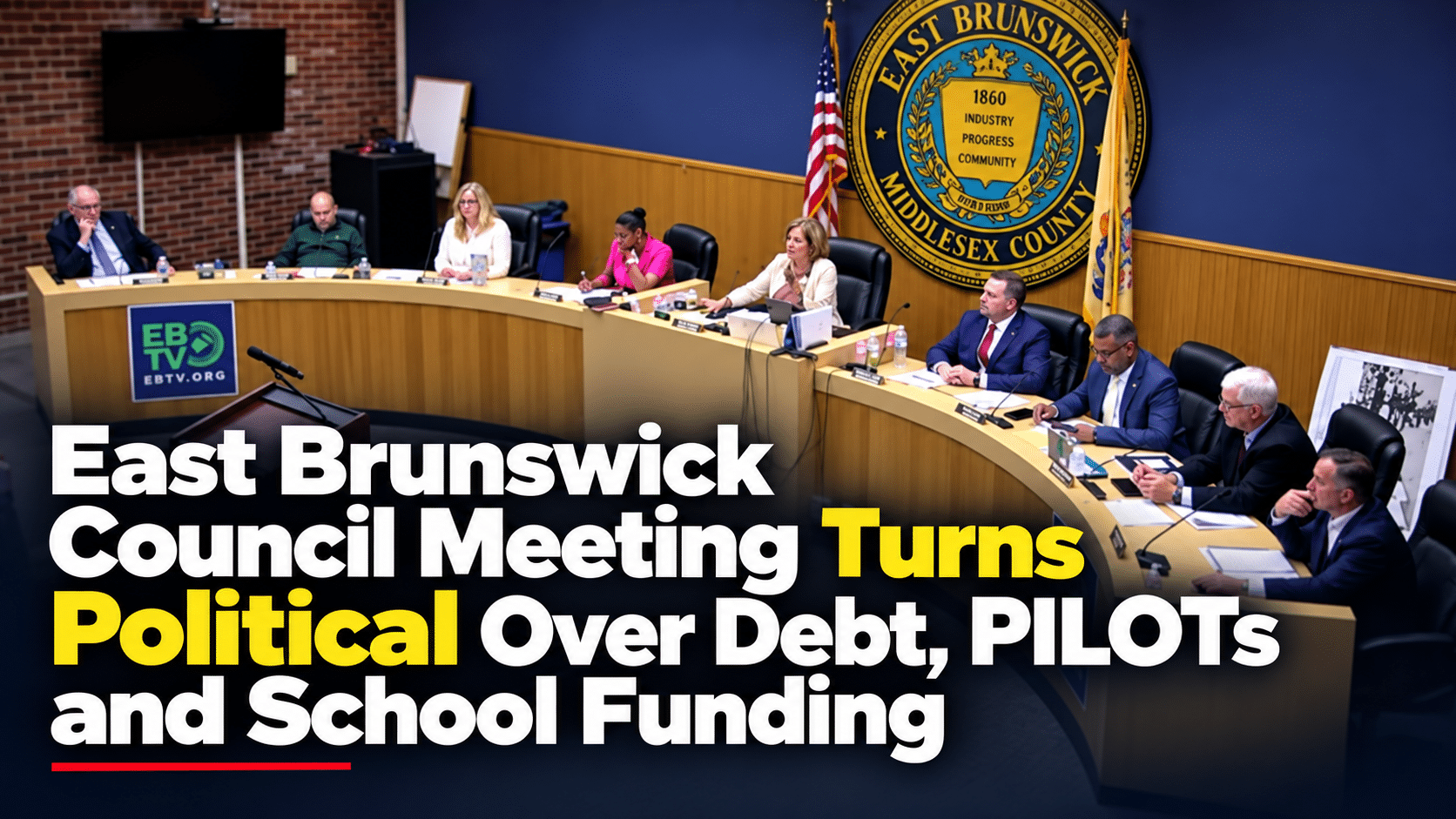
With Election Day just eight days away, Monday night’s East Brunswick Township Council meeting featured discussions about rising property taxes, municipal debt, redevelopment, PILOT agreements, school funding, and the relationship between township officials and the Board of Education.
Residents and candidates raised questions about township finances, a proposed group home on Amanda Court, and the ice arena concession contract.
The meeting also became a political debate. Three Republican council candidates questioned township decisions during public comment, while Councilman Jim Wendell and Mayor Brad Cohen later defended the township’s record, criticized the challengers, and encouraged residents to support the Democratic incumbents.
Cohen also publicly apologized for his recent criticism of the Board of Education and announced plans for regular meetings between township and school leadership, including discussions about PILOT revenue.
Both sides used the meeting to campaign. The challengers spoke during the five-minute public comment period, while officials responded afterward, when the public could no longer reply.
The full meeting video is on YouTube. Public comment begins at 43:34 and officials’ responses at 1:14:25.
Resident Raises Concerns About Rising Taxes and PILOT Agreements
Michael Deluchia, a longtime East Brunswick resident of Park Street, spoke about rising property taxes and the growing number of developments in the Township.
“I see so much building going on, the most building I’ve seen in a long, long time,” he said. “The problem I see, though, is the taxes keep going up.”
Deluchia questioned why new developments receiving PILOT agreements do not contribute conventional property taxes to the school district. He argued that while schools receive taxes on the land, they miss out on revenue that would ordinarily come from the buildings.
He also expressed concern about what happens when 30-year PILOT agreements expire, suggesting that homeowners could face substantial increases in their property tax bills.
Deluchia, 75, spoke about the financial pressures facing longtime residents, particularly seniors living on fixed incomes.
“It’s a sin in this community,” he said, criticizing the rising costs faced by people who have lived in East Brunswick for decades.
He also questioned why officials with past connections to the Board of Education hadn’t done more to address school funding.
His concerns about rising taxes and PILOT agreements would become a major topic of discussion later in the meeting.
Vazirani: ‘Show us the numbers’
Vazirani, who introduced himself as a banker and finance major, spoke about the property tax bill. He said the Township’s Aa1 rating from Moody’s and municipal tax increases of under 1 percent a year do not tell residents the whole story.
“Moody’s measures whether the township can pay its lenders,” he said. “It does not measure whether your property tax bill is affordable.”
He then cited figures:
- Net debt rose from about $32 million in 2017 to nearly $99 million.
- Annual debt payments rose from about $14 million to $18.5 million in one year.
- This year’s budget uses about $8.5 million in surplus, $4 million more than last year, to keep the tax increase under 1 percent.
“If I sat at my kitchen table and told my family our monthly expenses were under control, but failed to mention we were dipping deeper into our savings while carrying more debt, I wouldn’t be giving them the full picture,” he said.
On the ice arena, which he linked to about $40 million in debt, he asked how it is performing after seven months and how results compare with projections made before it was built.
He then asked about the Township’s agreements with developers: “How many developers were approached when these buildings were made? Why were 30-year PILOT agreements selected over shorter-term agreements like 10 years? What was the impact that was projected on our schools, traffic and taxpayers?” PILOTs, or payments in lieu of taxes, let developers of certain projects pay the Township an annual fee in place of conventional property taxes on their buildings.
“These are not anti-development questions,” he said. “Accountability should not be mistaken for opposition.” He closed by asking residents to vote for the Republican slate in Column A.
What the records show. Vazirani’s four figures match Township budget and debt records:
- Net debt was $32.5 million at the end of 2017 and $99.2 million at the end of 2025.
- Budgeted debt service rose from $13.9 million in 2025 to $18.5 million in 2026.
- The surplus used rose from $4.55 million to $8.55 million.
- The arena borrowing was authorized at $40.3 million in 2023.
Context he did not give:
- About half of this year’s increase in debt payments is school construction debt that the Board of Education repays to the Township.
- The Township’s net debt is still under a third of the state’s legal limit.
- Moody’s most recent report calls the debt “affordable” but above average for similar towns.
How the PILOT debate played out
PILOTs were the most contested subject of the night, but most of the PILOT discussion came from the officials, not the candidates.
The first mention came from a resident who is not a candidate. Michael Deluchia of Park Street said the schools “didn’t get any money” from the new developments. He said that “you have to have three other Republicans that point this out to you,” and predicted that buyers of 30-year PILOT townhouses would face steep tax bills later.
Vazirani’s PILOT remarks, quoted above, were three questions about the length of the agreements, how developers were chosen and what impacts were projected. They took about 15 seconds. He did not ask the Township to give PILOT money to the schools. Abdo and Le Blon did not mention PILOTs.
Wendell characterized the challengers’ campaign more broadly. He said they were “trying to pit pilot agreements and pilot payments against one another,” and that they “come up and talk about pilot funds and pilot funds and pilot funds every every meeting” and at “many, many” Board of Education meetings. He also said they made “false statements about how many students are coming out of the residences that receive pilot funds.”
The record supports part of that. Over the campaign, the challengers have argued at Council and school board meetings that the schools should receive a share of PILOT revenue:
- Le Blon raised PILOTs at four of the six Council meetings since Aug. 24.
- Vazirani raised them at three.
- Abdo raised them at one.
- At the two Board of Education meetings where candidates spoke, the Board had put PILOTs on its own agenda first.
- At the Sept. 28 Council meeting, Le Blon said about 130 additional students had come from three developments. District figures given since then do not support that number for those three developments.
- Vazirani’s Oct. 12 figure of about 230 students matched a count the district gave Oct. 8.
On Oct. 26, though, the only challenger PILOT remark was Vazirani’s question about why the agreements run 30 years.
Cohen answered that question in general terms. Developers would not have rebuilt the struggling Route 18 corridor without a tax incentive, he said, and “the first person who comes in gets the best deal” because “they took the greatest risk.” Later projects, he said, may get smaller incentives or none. He did not address 30 versus 10 years specifically, how many developers were approached, or what impacts were projected.
Cohen also raised the school question himself. “Can we talk about how some of that money can help with the schools? Great conversations to have,” he said. He added that PILOTs bring in “only about $2 to $2.5 million more” than when his administration began, against a school budget of about $210 million, and that sharing “will not solve the multi-million dollar budget deficits that the schools have.”
Under the Township’s PILOT agreements, the Township keeps 95 percent of the annual fee and the county receives 5 percent. The schools receive none of it, but they continue to receive their usual share of taxes on the land. Township budget records show PILOT revenue rose by roughly $1.75 million to $2.1 million between 2018–19 and 2025. The school district’s general fund budget is $209 million.
Abdo and the Amanda Court group home
Abdo said residents near a planned A+ Care group home on Amanda Court were told the Township “knew nothing” about it, yet found correspondence from the Township’s zoning officer about the property. Abdo also noted that the Township’s own affordable housing plan counts three A+ Care homes.
“I’m not suggesting that residents are entitled to confidential medical information, or that individuals with disabilities should be treated differently,” Abdo said. Abdo asked when the Township learned of the Amanda Court home and called for a process to give residents lawful information about future group homes. “Transparency should not begin only after residents discover what their government already knows.”
Business Administrator Joseph Criscuolo responded that group homes are “controlled and inspected by the New Jersey Department of Community Affairs,” and that “the township has nothing to do with it.” Any home can become a group home, he said, and state law calls for such homes to be integrated into neighborhoods. The state may ask the zoning officer and tax assessor about a property, he said, “but we don’t get asked, is it okay to put a group home there?” He confirmed the housing plan point: “The gentleman is right. We put it in our affordable housing plan.” Without its four group homes, he said, the Township would have had to build more affordable units.
Council President Dana Zimbicki said a resident who called had been advised to contact the state.
What the law says:
- Under state law, group homes for people with developmental disabilities or mental illness are permitted in every residential zone, and towns cannot require special approval.
- They are licensed and inspected by the Department of Human Services, not the Department of Community Affairs. The Township’s own housing plan names Human Services.
- Community Affairs’ role is fire-safety registration.
- Before a license is issued, local officials do sign off on the home’s certificate of occupancy and fire inspection.
- No law requires neighbors to be notified, and federal fair housing rules discourage such requirements.
- The Township’s plan credits three A+ Care homes with 10 bedrooms, and a fourth home run by another provider.
When the zoning officer’s correspondence was sent, and whether the Amanda Court home is one of the three already counted, remain open questions.
Le Blon Raises Questions About Ice Arena Concession Contract
Le Blon used his five minutes to criticize the Township’s February award of the contract to run food and beverage sales at the new ice arena. He called it “apparent corruption.”
He said the Township clerk had at first given him only part of the bid records he requested. He also said the winning company’s first submission lacked a required non-collusion affidavit. He then alleged that a person associated with the company has a federal criminal record and ties to organized crime, and told the Council and mayor, “All of you were complicit in it.”
The Council awarded the two-year contract on February 9 to F.A.V.M. Pizza Corp., after the highest-scoring proposer withdrew. The contract was approved by a 3–0 vote, with Councilwoman Dana Consoli-Winston and Councilman Dinesh Behal recusing themselves from the vote.
No Township official responded to Le Blon’s remarks during the meeting. Eyes on EB has not verified his allegations.
Wendell: ‘Where have you been?’
Wendell, a lifelong resident who said he has served on the Council “both elected as a Republican and elected as a Democrat,” said he had “never seen such a divisive nature from either party as we are seeing this year.”
He criticized a candidate for “bringing a family’s name into the public,” apparently referring to Le Blon’s remarks that night. He said the same candidate had made “light of the fact that the mayor was choking” at the previous meeting. On Oct. 12, Le Blon had told the mayor that “eating pizza immediately after a root canal may not be the wisest decision,” in remarks about police staffing.
Wendell said the challengers “only shown their face in the past six weeks” and “weren’t here in June for a primary.” Their first Council appearances came Aug. 24 and Sept. 14. Their names were not printed on the June primary ballot; the New Jersey Globe reported that they were nominated by write-in votes after Democrats challenged their nominating petitions.
He said the candidates’ public records requests had cost Township employees “countless hours,” and asked whether they had ever questioned the school board’s spending, such as why it “still serve[s] dinner every board meeting.” He also criticized what he called social media “rhetoric that is either wrong, skewed or is just sound bites.”
Wendell closed by asking residents to vote for himself, Councilman Kevin McEvoy and Councilwoman Consoli-Winston. “We are people who are here for East Brunswick,” he said.
Cohen: the tax record, the rink and ‘Johnny come lately’
Cohen began by saying the candidates “came up here for their five minutes of fame and then left, because they really don’t want to face any return fire.”
He defended the Township’s finances:
- Taxes: municipal taxes have risen under 1 percent a year during his 10 years as mayor, while employees received raises and the Township repaved roads, built a lighted cricket field and inclusive playgrounds, and expanded garbage service.
- Moody’s: “Moody’s doesn’t care if we’re Democrats or Republicans,” and it has found the Township “a good risk despite the increase in the debt, which is primarily due to the rink.”
- School and fire district debt: he said the debt figure “doesn’t take into account” the debt the Township carries for the schools and the fire districts.
- The rink: “Yes, we did build a rink because people in town wanted some community space.”
- The Republican years: “In the three years that the Republicans were in control, [taxes] went up 17%.”
Records show a more mixed picture on some of these points:
- The 1 percent claim: the Township’s municipal tax rate rose about 3.5 percent in 2017 and about 3.6 percent in 2019. In the other years of his tenure it rose about 1 percent or less.
- Net debt: the net debt figure Vazirani cited already excludes school and fire district debt, which Township debt statements subtract. Those debts do account for much of this year’s increase in debt payments.
- The rink: arena borrowing accounts for roughly 60 percent of the rise in net debt since 2017, though Moody’s does not mention it.
- The 17 percent figure: Eyes on EB could not confirm it.
- Bill share: all of these figures concern the municipal portion of the tax bill, about 20 percent of the total. Schools account for about 63 percent.
Cohen’s remarks about the candidates were pointed. “Johnny come lately,” he said, comparing them to a student padding a resume in senior year. “The judge has been retired for six years now. Where has he been? Nowhere.” Le Blon retired from the bench in 2022 and served on the Council and as Planning Board chair in the 1990s. Cohen said the candidates had been seen at a recent fundraiser “walking around like a deer in headlights.” He also said “the only way they know anything about” redevelopment “is because they did an OPRA request, which any one of you could do.”
On redevelopment, Cohen held up photographs of vacant Route 18 properties. “That’s what we inherited,” he said. The Township, he said, is not spending tax money as a developer. It uses tax incentives to attract private investment where nothing was being built.
On Route 18, he said state construction “is done” except for overnight paving. He rejected a candidate’s past proposal for a parallel road, saying it would require buying property and would send traffic through neighborhoods.
“Critics are a dime a dozen,” he said. He then asked residents to support McEvoy, Wendell and Consoli-Winston, “who have given a lifetime of service to this community.”
The mayor’s apology to the Board of Education
In the middle of his remarks, Cohen returned to his criticism of the Board of Education at the Oct. 12 meeting, where he had called some school claims “ridiculous” and accused the district of spending “like drunken sailors.”
“Last time when I addressed the public, I was a little harsh when it came to the board of ed,” he said. He said his “understanding is that the dinners for board of ed members has stopped.” That came about 10 minutes after Wendell had said the board “still serve[s] dinner every board meeting.” Eyes on EB has not confirmed whether the dinners have ended.
Cohen said his relationship with past school administrations had often been “strained,” and that he became concerned when the board “appeared to align itself with the talking points of the township council election.” Then he apologized. “I regret that tone, and I am sorry for any offensive words that I said and any damage that I may have caused,” he said.
He said he had since met with board leadership and was “assured that there’s no connection or tacit support for council candidates.”
Cohen also announced that school board leadership, Zimbicki and he have “begun to set up regular meetings.” Topics would include “pilot revenue, security, use of facilities, programs, shared services.” He did not say when the meetings would begin or whether they would be public.
Eyes on EB received an anonymous email describing a heated private meeting involving Mayor Cohen, Council President Dana Zimbicki, and Board of Education leadership.
While Cohen publicly acknowledged meeting with board leadership, Eyes on EB was unable to obtain on-the-record confirmation of the details shared in the email. For that reason, we have chosen not to publish those claims at this time.
Zimbicki: ‘No place for ugly’
Zimbicki said East Brunswick is “one community” and “there’s no place for ugly in East Brunswick.” She apologized to Township Clerk Tamar Lawful for comments a speaker made “a few meetings ago” suggesting that answering records requests required only pushing a button. She said one request covered “10 years’ worth of documentation.” At the Sept. 14 meeting, Le Blon had described clerk responses as “pressing a computer button.” Earlier on Oct. 26, Le Blon had also criticized the clerk’s handling of his concession records request.
“For eight weeks now, we’ve had people coming into the chamber preaching and presenting information, some not accurate at all, some skewed,” Zimbicki said. She praised McEvoy, Wendell and Consoli-Winston for their work. She is not on this year’s ballot.
On records requests. None of the officials questioned residents’ right to file public records requests, and Cohen noted that any resident can. Their objection was to the staff time involved. Under the state’s Open Public Records Act, people generally do not have to say why they want public records.
Other business
- Honored for saving the mayor’s life. The Council honored Robert Hughes, a Coast Guard veteran, and his wife, Tanya. Robert Hughes helped Cohen during an Oct. 6 choking emergency. Cohen said a woman whose 38-year-old son died after choking wants to start a foundation that would put rescue devices in restaurants and train staff, using East Brunswick as a pilot. He asked residents interested in serving on that committee to contact him. Criscuolo noted that more than 100 Township employees are certified in CPR and the use of defibrillators.
- Proclamations. October was recognized as National Women’s Small Business Month, with members of the East Brunswick Regional Chamber of Commerce, and as Fire Prevention Month, with a proclamation for each of the three fire districts.
- Oliver Court parking. The Council adopted, five to zero, weekday time limits on Oliver Court parking. One resident objected that the restrictions were unnecessary. Zimbicki said every resident on the block asked for them.
- Police contracts. The superior officers’ contract is complete, Cohen said. Terms of the rank-and-file PBA contract have been agreed and are likely to come to the Council at its next meeting. The Council ended in closed session to discuss the PBA negotiations, with no action taken.
- New businesses. Cohen said Nordstrom Rack opens this week as the first store in the Brunswick Square Mall redevelopment, with J.Crew, a PGA golf store, Fun City, an indoor pickleball center and a Hackensack Meridian facility expected in the coming months. He also cited recent openings of a senior day-health center and a restaurant, 18 East.
- High school ramp paving. The ramp from East Brunswick High School to Summerhill Road is scheduled to be milled and paved Oct. 28–30, weather permitting, Criscuolo said. Buses will use an alternate exit, and a police officer will direct traffic.
- Crosswalk question. Wendell asked about social media reports of a planned crosswalk and traffic changes at Dunhams Corner and Fern roads. Criscuolo said he would report back.
- State aid checklist. The Township again earned enough points on the state’s annual Best Practices checklist to receive its full state aid allocation, Criscuolo said.
- Consent agenda. The Council approved 11 routine resolutions together, five to zero, including the roof contract and bid rejections described in our agenda preview.
- Leaf collection starts Monday, Criscuolo told a resident.
- Mall tax appeal. Answering a resident, Criscuolo said the owners of the Brunswick Square Mall won about $1 million back on a tax appeal covering years when a prior owner held the property, and that the Township paid the refund from municipal funds.
- Referendums. Another resident asked the Township to put more major projects, such as the ice arena, to referendums. Criscuolo noted that the school board needs voter approval only to exceed its 2 percent budget cap.
- Gaza conflict. The first public speaker, a Berkshire Way resident, called on the three incumbent council candidates to take a public position on the conflict in Gaza and urged the Township to end its sister-city partnership with Yavne, Israel. The speaker also encouraged residents not to vote for candidates who had remained silent on the issue. Council members did not respond during the meeting.
- Election reminder. Township Clerk Lawful said early voting runs through Sunday, Nov. 1, at the Community Arts Center, 721 Cranbury Road. There is no in-person voting Monday, Nov. 2. Election Day is Tuesday, Nov. 3, with polls open 6 a.m. to 8 p.m.