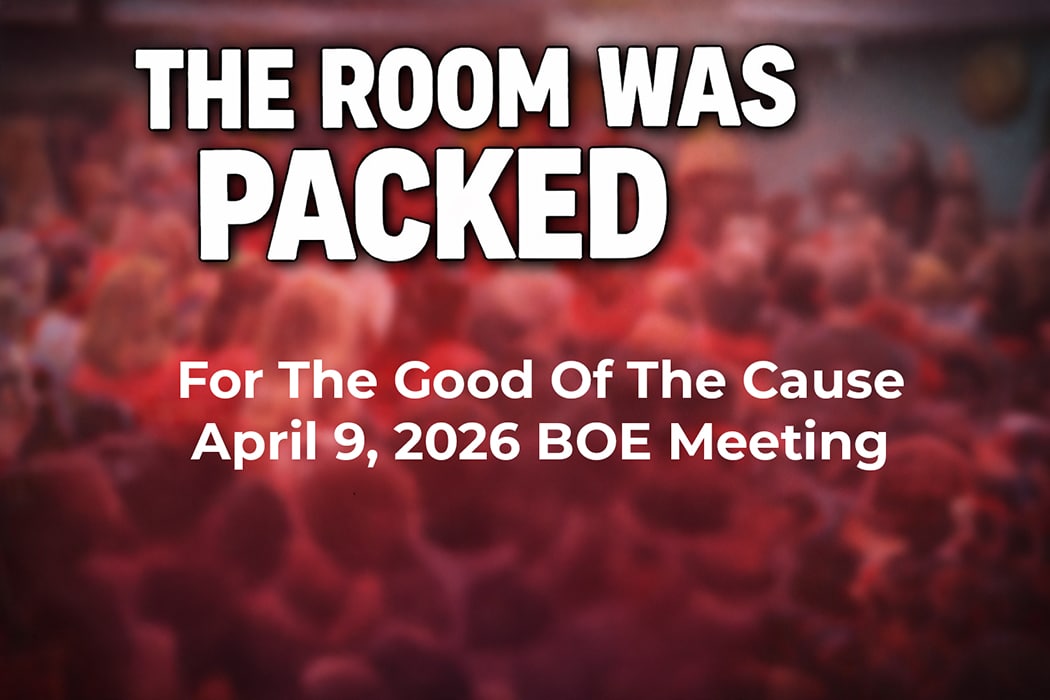
The room was full. Not just full—packed. And when that filled up, people stood in the hallway. Dozens of them. Some waited hours and never even got to speak.
This all unfolded during the “For the Good of the Cause” portion of the meeting—the part where the public gets to speak.
That alone tells you what kind of night this was.
The East Brunswick Education Association had called people out to support the district’s custodians, and the community showed up in force. Red shirts, standing room only, and a clear message: this decision matters.
Because this isn’t just about a budget gap. It’s about who takes the hit.
“Budgets Are Moral Documents”
One speaker summed up the entire night in a single line: “Budgets are moral documents.”
That’s what this comes down to. You can talk about numbers, state aid, and deficits—and those are real—but eventually every budget becomes a statement of priorities. What you keep tells people what you value. What you cut tells people what you don’t.
And on this night, the conversation centered around one potential cut: outsourcing custodians.
Dana Zimbicki: “This Is Not Just a Budget Decision”
If there was one voice that carried through the room, it was Dana Zimbicki, president of the East Brunswick Education Association. And she didn’t come up there to politely disagree.
She came up there angry—and she said it.
She started by calling out the moment itself. Not the budget. Not the numbers. The process.
People had been standing in the hallway for over two hours. Parents, staff, community members—waiting to be heard, many of them never getting the chance. And her point was simple: if this many people show up, you don’t squeeze them into a room that can’t hold them.
But that was just the beginning.
Once she got into the substance, her message sharpened fast. This wasn’t just about custodians. This was about how decisions are being made—and who is being asked to absorb the impact of them.
She challenged the idea that privatization is some kind of practical solution. Not emotionally—factually.
She pointed to other districts dealing with the same state aid issues. Districts that didn’t make this choice. Districts that found other ways to manage the pressure without removing people who are embedded in their schools.
Then she broke down what privatization actually means in the real world—not on paper.
Short-term savings that don’t last. Contracts that increase over time. Less control over your own buildings. More turnover. Less accountability.
And then she brought it back to the people.
She talked about what she had been hearing in the days leading up to the meeting—about custodians potentially being pushed out, about people being told not to worry because they could “retire,” about the idea that they might be picked up by private companies but without the same stability or benefits.
And that’s where her tone shifted from frustrated to direct:
“These are real people doing essential work.”
She made it clear that this isn’t a replaceable function. These are not “seconds.” These are not interchangeable roles. These are people who know the buildings, know the students, and are part of the daily rhythm of the schools.
Then she pointed to something that hung in the room a little heavier than everything else.
If this district is trying to “preserve what it has”—a phrase that had been used earlier in the meeting—how does removing people who have been part of that system for decades fit into that goal?
Because you can’t say you’re preserving something while actively removing the people who helped build it.
That was her message.
And whether you agreed with it or not, it was impossible to ignore.
A Third Grader Might Have Said It Best
Before any of the adults got up, a student spoke. Actually, a whole class did.
A third-grade class wrote a letter about their custodian, Mr. Oscar. No politics, no strategy—just what they see every day.
They talked about how he helps when there’s a problem, how he knows them, how he jokes with them, how he shows up. They called him kind. They said he smiles. They said they would miss him if he was gone.
That’s the part you can’t quantify. But it’s also the part that defines a school.
What Custodians Actually Do (According to the People Who Work With Them)
One of the biggest themes of the night was this: people kept pushing back on the idea that custodians are just cleaning staff.
Teachers, staff, and even former students described something very different.
They talked about custodians being the first ones in the building and the last ones to leave. They talked about them responding immediately when something breaks, when a classroom becomes unsafe, or when something just isn’t right.
They talked about experience—knowing the building, knowing the systems, knowing the people. That kind of knowledge doesn’t transfer to a rotating outside crew.
One teacher put it plainly: once that level of awareness is gone, you don’t get it back.
Another described them as the eyes and ears of the school—people who catch problems before they become bigger ones.
And multiple speakers pointed to something already happening in the district: issues with privatized night custodial work—missed tasks, communication problems, and inconsistent performance.
That wasn’t theory. That was experience.
The Word That Kept Coming Up: “Community”
Nobody coordinated this, but the same idea kept coming up over and over again.
Community.
Custodians said it. Teachers said it. Students said it.
One custodian said, “I’m not just a custodian. I’m part of this community.”
And that’s really the tension here. Because outsourcing doesn’t just replace workers—it replaces people who are embedded in the day-to-day life of these schools with people who aren’t.
You lose familiarity. You lose relationships. You lose accountability that comes from actually being part of the place you’re working in.
It Wasn’t Just Custodians
While the custodial issue dominated the night, it wasn’t the only concern.
Residents also spoke about the proposed expansion of the Frost School parking lot. Concerns ranged from environmental impact and drainage issues to safety risks and the loss of green space that the community actively uses.
Others spoke about rising taxes and frustration with transparency around the budget.
And then there was another recurring theme: people understand there is a budget problem—but they’re questioning how the solutions are being chosen.
The Board’s Position
The board did respond, and the message was clear: nothing has been finalized.
They explained that they are required by law to notify the union before outsourcing is even considered and that the current phase is about “impact bargaining,” where the union has the opportunity to propose alternatives to close the budget gap.
They also emphasized the scale of the problem: a multi-million-dollar shortfall even after a significant tax increase.
In other words, they’re saying this isn’t about preference—it’s about necessity.
But that doesn’t mean the community sees it that way.
What This Night Actually Showed
This wasn’t a typical meeting.
This was a community drawing a line.
Not necessarily saying “ignore the budget,” but saying, “be very careful what you choose to cut.”
Because once you remove people who have been part of these schools for decades, you’re not just making a financial decision.
You’re changing the culture of the district.
And as one speaker made clear, that’s not something you can easily reverse.
We queued up the For The Good Of The Cause Portion, click play!