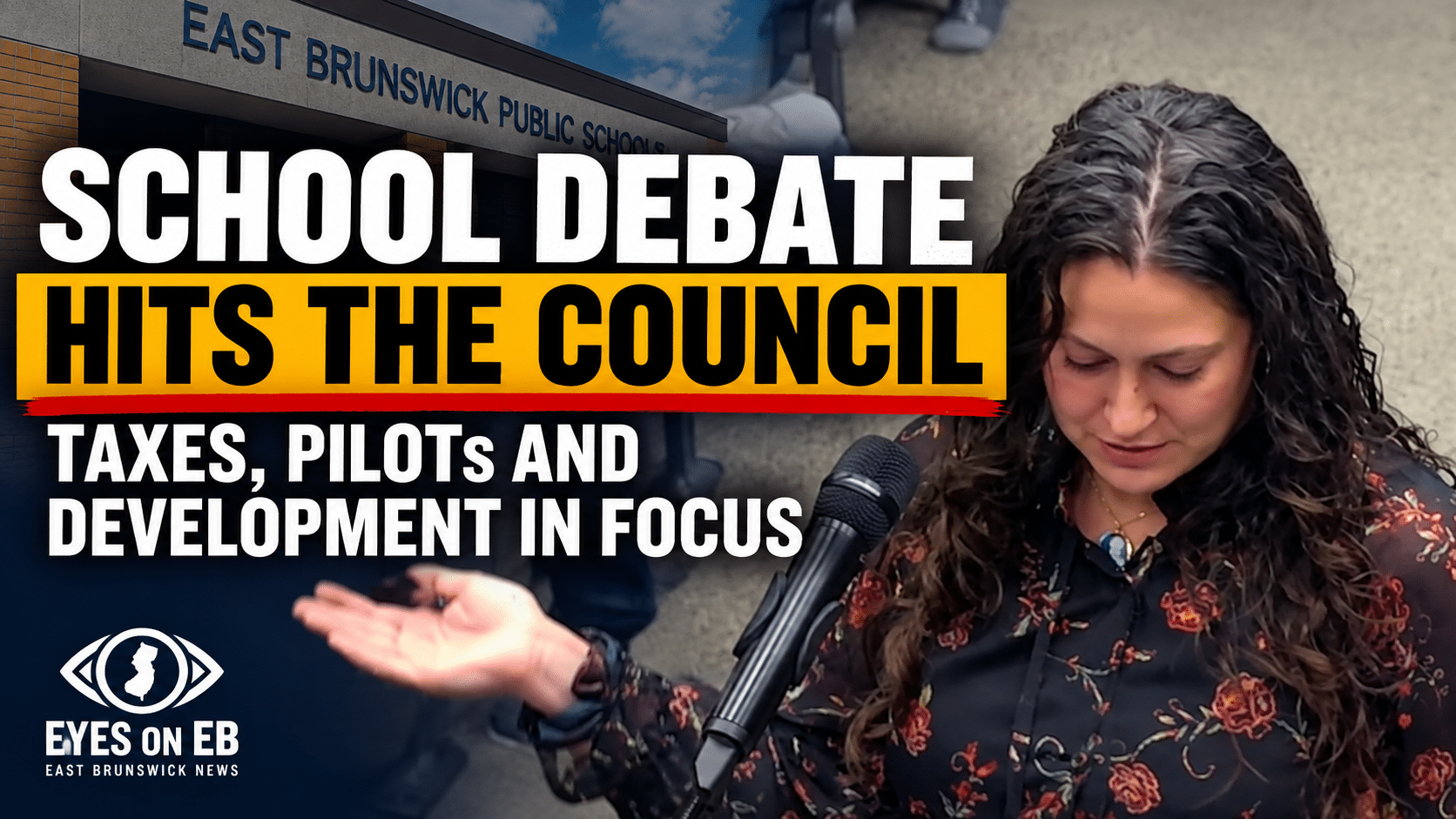
For the second meeting in a row, East Brunswick residents brought school funding, taxes and development to the Township Council. On Sept. 28 the debate turned political.
For much of the past year, East Brunswick’s school debates have played out at the Board of Education, over its budget, its tax increase, redistricting and the future of the high school. This month, residents have been carrying those concerns across town to the Township Council.
The Sept. 14 Council meeting drew one of the largest public-comment turnouts in Eyes on EB’s records of Council meetings going back to 2022: 17 speakers in general public comment, plus six more at a public hearing. On Sept. 28, seven residents spoke during about 25 minutes of public comment, and school funding, property taxes and payments in lieu of taxes, or PILOTs, again dominated.
The Council doesn’t set the school budget. But it does approve the redevelopment agreements, PILOTs and municipal budget that residents increasingly see as tied to what happens in the schools. It’s good to see more of them paying attention to both bodies.
‘Why is my tax bill higher?’
Three of the speakers are the Republican candidates for Township Council.
Girish Vazirani, said he was speaking as a candidate and also “as a parent, long-time East Brunswick resident, and a taxpayer.” After questions about the ice arena’s finances, he turned to taxes. Homeowners get a single bill, he said, and “that school tax bill has gone up by 6%, while the township municipal levy is only 1%.” Budget records bear that out: the school tax levy rose 6.16% for 2026-27, and the Township’s municipal levy rose 0.99%.
Vazirani asked why the Township couldn’t “coordinate better with the school board,” and pointed to Clark Township, which he said adopted an ordinance in 2024 giving its schools a defined share of PILOT revenue.
Mina Abdo, the third candidate on the slate, spoke about Route 18 traffic and asked residents to elect “Judge Le Blon, Girish Vazirani, and I.”
Vincent Le Blon, a retired Superior Court judge and former Council president, built his remarks around the Sept. 24 Board of Education meeting. He said the board’s attorney had explained that the school district gets no share of PILOT service charges: “The township receives 95%, the county gets 5%.” The Council, he said, “had the power to prevent a tax increase by working with the Board of Education,” and had not lobbied “our state Democratic legislators” to change the school funding formula.
He then addressed Council President Dana Zimbicki directly: “I think I saw you hiding in the back of the Board of Education meeting. I don’t know how you explained to your union members that they had to suffer through threats of layoffs.”
Board of Education records list Zimbicki as president of the East Brunswick Education Association, the union representing district teachers.
‘I’m not running’
Before the meeting, Eyes on EB received information that Democrats were expected to attend to counter the Republican candidates. We could not establish whether anything that happened at the meeting was connected to that information. We have no evidence that anyone sent any speaker, coordinated with anyone, or spoke on behalf of any party or candidate. What follows is what happened.
The next speaker was Dave Lonski of Kentisbury Circle. “I’m not running,” he began. “I think the other three were all candidates.”
He then took on the candidates’ arguments one by one. Over the past six or seven years, he said, “the state funding for schools has nearly doubled from $20 million to $40 million.” He said the suggestion that local legislators “aren’t doing their job” in increasing school aid is “just completely inaccurate.” On enrollment: “About 8,100 students every single year for the last 15 years. Hasn’t changed.” On spending, he said the school budget “has increased from $164 million to nearly $210 million, nearly $45 million of additional spending.”
But those numbers don’t answer two questions residents have been raising. Stable enrollment does not mean the students sitting in classrooms today have the same needs or cost the same to educate as students did years ago. And it does not answer the PILOT question: if new development brings additional students into the district, should some of the revenue it generates follow those students to the schools?
The schools are not entirely excluded from tax revenue connected to a PILOT property. The district continues to receive its share of conventional property taxes on the land assessment. But the PILOT payment on the development itself is distributed differently, with the Township receiving the overwhelming majority and the county receiving the remainder. The school district does not receive a direct share of that PILOT payment.
The question, then, is whether some of that revenue should go directly to the district when development adds students and costs, and whether it should be a defined, recurring amount the schools can count on when building a budget rather than depending on individual projects or assistance from the Township.
“It’s not because of these nuances that the Republican candidates keep coming up with,” Lonski said. “It’s the cost of education that’s increasing.”
But the PILOT question did not begin with the Republican council candidates or this election. Their campaign has picked up on concerns residents were already raising about school funding and development. Whether new development should provide a predictable revenue source for the schools has become a broader community question, not simply a campaign talking point. Anyone who has followed these discussions in East Brunswick has heard the issue raised long before these candidates brought it to the Council microphone.
‘That gentleman might not be running’
Allegra Seidler, a regular attendee at Board of Education meetings who has closely followed the district’s budget and school issues, spoke next and addressed Lonski directly.
“That gentleman might not be running, but he does sit on the board of the Middlesex County Democratic Organization,” she said. “So that might be useful information for some people to have.”
Seidler was correct. The Middlesex County Democratic Organization currently lists Lonski as its General Counsel and a member of its Executive Board.
Township records show Lonski has held a local Democratic leadership role. Council minutes from January 2025 identify him as “East Brunswick Democratic Committee Chairman,” and minutes from January 2022 list him as “Democratic Chairperson.” He has also done legal work for the Township. He was named from the dais in January as assistant township attorney, and his firm, Shamy, Shipers & Lonski, holds 2026 Township appointments as tax appeal attorney and, jointly, municipal prosecutor.
Seidler then raised something that raw enrollment totals don’t capture: the needs of the students who make up that enrollment.
“The budget has increased because special ed is now 20%, which has increased needs and costs,” she said. “Healthcare costs went up 22%, and the board of ed spoke about this.” The Board’s March budget presentation lists health premiums increasing 22%, a $7.9 million increase.
“Enrollment is not just numbers in front of you,” Seidler said. “It’s who’s in front of you.”
Her point was that a relatively stable enrollment does not necessarily mean the cost of educating that enrollment has remained stable. She told the Council it has the power to write school payments into PILOT agreements, and that if it won’t, residents deserve a clear answer.
“We all want to know,” she said. “What do you really think?”
Watch Here
The Council responds
After public comment closed, Zimbicki said the Township received about $1.6 million in additional PILOT money in 2025 and 2026. She said some went to school projects with the Board of Education, including parking-lot paving and planned stadium bathrooms, and the rest to three more police officers and expanded services.
A Council member said school enrollment is “down 300 students” from six years ago and called school budget growth “of over $48 million” in six years “crazy,” while the Township has held its own increases to “less than a 1% tax increase year over year.”
The mayor: ‘Transparency works both ways’
Mayor Brad Cohen then spoke for about 15 minutes.
He opened with the Brunswick Square redevelopment plan adopted that night, which he said the Township had to pass under a court-driven affordable housing timetable or risk a “builder’s remedy.” He has held more town halls “than any other mayor that I could think of,” he said, where “I get a handful of people that show up.” It’s election time, he said, “so I’m sure there’s a reason why everybody’s coming out here and rallying to a cause. I get that.”
“To say that we don’t really care about the schools would be … factually incorrect,” he said.
He said special education students make up “about 20% of the school population right now,” and that for three years he has asked the Board for a “profit and loss on special needs.” “I asked for that in August of 2023, and I’m still waiting for that data from the schools. So transparency works both ways.” When he served on the Board, from 2010 to 2016, he said, the figure “was a single digit … somewhere around 6%.” Federal education data for those years show East Brunswick between about 13% and 15.5%; the state’s most recent figure is about 18%.
Rising health costs, he said, “will be a massive burden on this community.”
On PILOTs, Cohen said the Township has “just started,” with “a handful of pilots” in developments that aren’t yet fully occupied, “a cookie jar that doesn’t really have a whole lot of cookies in it yet.” Once development measurably affects enrollment, he said, “a conversation about how we can help shoulder that burden is not unreasonable.” For now, he said, enrollment “has not changed in 15 years,” and “there’s no proof that any of the development that’s been done has had any impact on the school.”
“We’re not remotely close to full capacity,” he said, “but I’ve spent 10 years hearing the board scare the bedoodles out of people, thinking that … we were busting at the seams and we were going to need to build $500 million new schools.”
Yes. I think that is an important qualification to Cohen’s “not remotely close to full capacity” statement, but I would frame it around distribution and school-level capacity, rather than saying he ignored equity as a conclusion.
The district itself has said it tracks enrollment effects on individual classroom capacity, including room square footage, Board policy, state facility standards and federal special-education class-size standards. That supports the basic point that a districtwide enrollment total does not tell you whether particular schools or classrooms are crowded. East Brunswick Public Schools
Right after Cohen’s quote, I’d add:
But districtwide capacity does not tell the whole story. A district can have available space overall while individual schools and classrooms face very different pressures, particularly when hundreds of new housing units are concentrated in one area. Redistricting can move students between schools, but it does not eliminate the cost of educating them or the services they require. This also becomes an equity issue.
That also matters to the PILOT debate. If a development adds students, those costs do not disappear because districtwide enrollment remains relatively stable. Existing homeowners are not relieved of their school-tax obligation simply because districtwide enrollment is flat or because their own household adds no children to the schools. The question is why new development should be treated differently, and whether some of the revenue it generates should help support the school system serving its residents.
Four days earlier, the district’s business administrator, Joseph Crotchfelt, had described capacity using the state’s square-footage standard. By that measure, he said, the high school is “over capacity by 463” students and Churchill Junior High “by about 650.” He added: “Fire code, we’re fine.”
Cohen closed by calling much of what had been said “misinformation,” voiced “in the middle of a campaign season where everybody wants to try to get an edge.” The way forward, he said, is a town where the Council, residents and school board “are all on the same page.”
But in suggesting these concerns are a product of campaign season, Cohen was presenting an inaccurate picture from the dais. East Brunswick has debated development, school capacity, and the relationship between PILOT revenue and the schools for years. The campaign has brought more attention to those concerns, but it did not create them. These are longstanding community issues, and anyone who has regularly followed the Board of Education and Township Council has heard versions of them well before this election.
What comes next
Whether PILOT agreements should set aside money for the schools, and who pays as costs rise, remain open questions. Because each calendar-year tax bill covers two school budget years, the school portion of 2026 bills should rise by about 4.9%, with the rest of this year’s increase arriving in 2027.
If the last two meetings are any indication, both the Council and the Board of Education are now hearing many of the same questions.