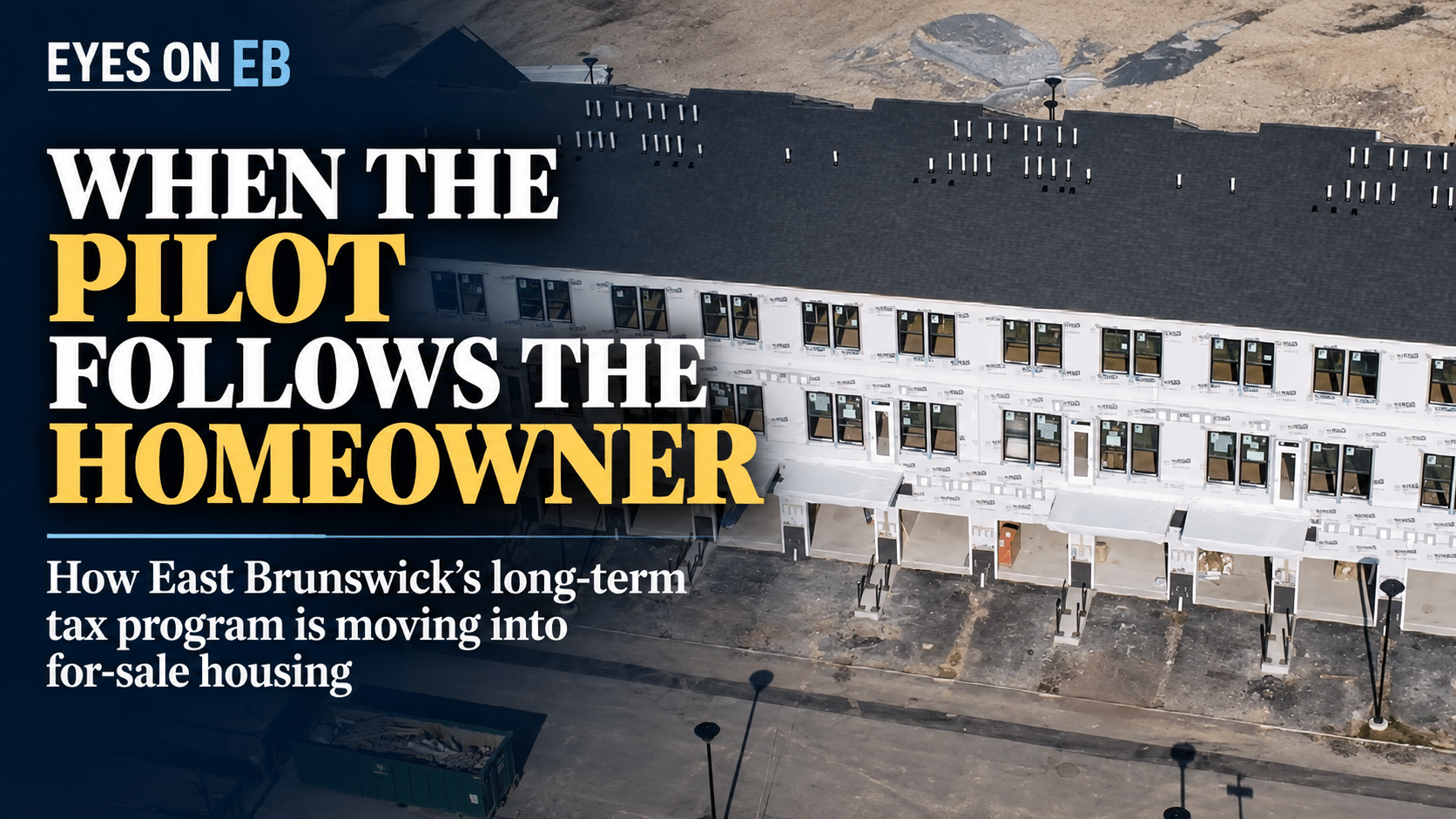
At the Route 18 redevelopment most people call Vermella, the for-sale townhomes are advertised with “a 30 Year tax PILOT Program that saves you thousands in annual taxes.” The claim is accurate. But it describes a tax structure East Brunswick has so far used only for warehouses, offices and rental buildings — and one that, this time, will follow each buyer into the house.
EAST BRUNSWICK, NJ — Along Route 18, on the site of the old Loehmann’s Plaza, East Brunswick is getting the redevelopment most people in town simply call Vermella: apartment buildings, retail, a grocer, restaurants, medical offices and a park.
Behind the apartments, in a third phase, are 219 townhomes for sale. PulteGroup is marketing the homes it is building there as District Walk, priced from $599,990 to just over $800,000.
On the builder’s website, in the list of things that make the community worth buying into, one item sits directly beneath “Highly regarded school district.” It reads: “30 Year Tax PILOT program.”
That is accurate — it describes a real term of an ordinance the Township Council adopted in November. But it also describes something most homebuyers have never encountered: the same tax structure East Brunswick has used for a distribution warehouse, a commercial parcel and apartment buildings.
Here it is being attached to houses people will own.
Four names, one project
These deals are hard to follow partly because everything has two names.
Vermella East Brunswick is the whole Route 18 redevelopment, and one financial agreement — Ordinance 25-37, adopted November 24 — covers all of it.
That agreement provides for 219 for-sale townhomes across three lots. In November the council assigned one of those lots — 104 units — to a Pulte entity, PHM East Brunswick. District Walk is the name Pulte uses for the homes it sells there. The other two lots, 115 units between them, remain with EB Development III; whether they will carry the same name is not in the public record.
Vermella has not yet produced a dollar of PILOT revenue. The exemption has not started. Every parcel is still on the ordinary tax roll, paying $361,043.20 in property tax in 2025 and $1,014,599.32 in 2026 — the increase coming from the townhouse lots being subdivided and assessed for the first time.
And the two residential halves work differently. The apartments will pay 10 percent of the rent the buildings take in, billed to the company that owns them. The townhomes are the unusual part.

What a PILOT is — and what it isn’t
Under New Jersey’s Long Term Tax Exemption Law, a town can agree that the buildings a developer puts up will be exempt from ordinary property tax and pay a negotiated annual service charge instead. That can run for up to 30 years. The exemption covers the buildings. It does not cover the ground they sit on, and that distinction does most of the work in everything below.
One clarification, because the words get used interchangeably. New Jersey also has a separate five-year abatement law, which phases in the taxes on an improvement to a home or building. If you have heard of a neighbor getting “an abatement” on an addition, that was almost certainly it — applied to their own assessment, and over in five years.
District Walk is not that. It falls under the long-term law: up to 30 years, a corporate “urban renewal entity,” and an annual service charge that replaces the tax on the building entirely.
What changes when it’s a house
Three things.
The obligation follows the buyer. Under state law, a purchaser “shall acquire title to the unit subject to the requirement for payment of the annual service charge.” The financial agreement is recorded against the property as a municipal lien and a covenant that runs with it. A buyer takes the home subject to the annual service charge. That obligation follows the property, and in the early years it is designed to cost less than conventional property taxation.
The charge is not based on an assessment. This is the part with no equivalent in ordinary homeownership. Instead of assessing the house and applying the tax rate, the agreement takes 10 percent of an imputed rent — the monthly mortgage payment a buyer would make on the purchase price at the prevailing 30-year rate, plus the monthly homeowners’ association dues, multiplied by twelve. A buyer who pays cash is charged as though they had borrowed.
The agreement supplies its own worked example. On a $750,000 townhome, assuming a 7 percent interest rate and $325 a month in dues, it puts the annual service charge at $6,377.72. That is the contract’s own illustration, using assumed numbers — not a bill, and not a figure from East Brunswick.
The owner still pays some conventional tax. The land is never exempt, so a share of ordinary land tax remains due, and the agreement adds a 2 percent administrative fee payable by “each owner of a for-sale unit.” A District Walk owner is not tax-free. They are paying on a different basis.
What any of it will actually come to is not yet on any public record: no unit has been completed, conveyed, assessed or billed, and the first homes are due between September and November.
What “30 years” actually means
Not thirty years of the same low payment.
Each unit gets its own 30-year clock, starting when that particular home is finished. For the first five years the charge is what the formula produces. From year six it rises by at least 2 percent a year.
Then it steps up against what full taxation would cost. In years 16 through 20 the charge must be at least 60 percent of what the property would otherwise owe. In years 21 through 25, at least 70 percent. In years 26 through 30, at least 85 percent. After that the exemption ends and the home is taxed like any other.
The advertised saving is real, largest early, and narrows substantially in the second half. “30 Year tax PILOT Program” describes how long the program runs, not how long the discount stays the same size.
How unusual is this?
Less unusual than it sounds, and less ordinary than it looks.
None of the machinery is new. New Jersey’s long-term exemption law dates to 1991, and it includes a section written specifically for condominium units sold to individual buyers. Residential PILOTs are not new either — the state’s Department of Community Affairs counted 1,389 affordable housing developments operating under PILOT agreements in 2024 alone. But that is a count of affordable housing, not of market-rate homes sold to individual buyers — and the two are not the same use of the law.
But that is where the mechanism is normally found: affordable housing, rental buildings, redevelopment in cities with long histories of disinvestment, and projects clustered around transit. Where individual homeowners do pay a service charge, the documented examples are largely urban: condominium buyers in Jersey City have paid them for years, and the State Comptroller’s statewide review pointed to market-rate condominiums there and in Asbury Park.
The closest suburban, for-sale comparison Eyes on EB could find is Somerville Station in Somerset County — 156 townhomes, also built by Pulte, on a former landfill directly beside a rail station, which is what its redevelopment case rested on.
What is less familiar is the combination East Brunswick now has: new market-rate townhomes, sold to individual homeowners, in a suburban township with no rail hub — with the long-term tax treatment promoted directly to purchasers as a selling point.
A caution on that. Eyes on EB did not conduct a statewide census, and New Jersey publishes no registry of these agreements by whether the housing is rented or owned. We cannot say this is a first, and we are not saying so. What the evidence supports is narrower: this is a less familiar application of the law than the ones it is usually associated with.
What East Brunswick’s own record shows
Locally, the machinery has been sitting unused.
The 2011 agreement covering the Route 18 apartments states that service charges on any residential unit “conveyed to an Owner shall be paid by the applicable Owner, and not the Entity.” The 2020 Legacy Place agreement has a section headed “For Sale Units.”
Neither has ever worked that way. Legacy Place, on Tices Lane, was built as rental housing — the township’s own housing plan lists it as family rental. The Route 18 apartments are rentals too. The remaining agreements cover a warehouse, a commercial parcel, an assisted-living facility and three affordable rental developments dating back to 1978.
Not one has ever sold units to individual owners, and every payer identified in the township’s revenue records is a company. District Walk appears to be the first time this structure will actually reach a homeowner here.
For comparison: how it works on a warehouse
The clearest way to see the two halves of a PILOT is a commercial property where the money has already changed hands. This is not the subject of the story — it is the worked example.
First, one term. Assessed value is what the township’s assessor puts on a property for tax purposes, not what it would sell for. East Brunswick has not revalued in decades, so its assessments run at roughly 19 cents on the dollar of market value townwide — a ratio for the town as a whole, not a measure of any one property, and it applies to your house as much as to a warehouse.
At 39 Edgeboro Road there is a distribution warehouse. The tax roll values the land under it at $700,000 and the building at $8,864,000. In 2025 its owner paid $86,590 in ordinary property tax on the land — and nothing on the building. It also sent the township $1,151,450 in service charges for the year. Of that, $56,361 went to Middlesex County and the township kept $1,095,089.
One wrinkle runs opposite to expectation: the land tax the owner pays in full is credited back against the next year’s service charge, out of the township’s share — which is why the two payments should not be added together.

What the schools receive, and what they don’t
This is the part residents most often get wrong, in both directions.
The school district receives no share of the service charge. Under these agreements the entire charge is divided between the township and the county.
The district does, however, continue to receive its normal share of the tax on the land, which was never exempt. At 39 Edgeboro Road that came to about $55,400 in 2025.
So both of the sentences people reach for are wrong. “The schools get nothing from PILOT properties” is inaccurate. So is “the schools do fine out of PILOTs.”
For scale, the township publishes its own comparison every year, in a column headed “Taxes if Billed in Full.” For that warehouse’s building in 2025 the figure is $1,096,477, which divided conventionally would have sent roughly $702,000 to the schools, $216,000 to the township and library, and $165,000 to the county.
A warehouse, of course, does not send children into the school district, and senior-living developments generally do not either. Housing aimed at families is different. That makes the school-share question more consequential once the same tax structure is attached to for-sale townhomes. Whether it helps or hurts the district depends on how many students the development produces, what they cost to educate, how much state aid follows them and whether existing classrooms and staff can absorb the growth.
Three things travel with that comparison: it is the township’s own hypothetical, not a bill anyone received; it assumes the building would exist, and be worth the same, without the exemption, which the township disputes; and it rests on those same unrevalued assessments. It is not money the schools lost; it is money that would have existed under a different arrangement.
The same structure will apply to the for-sale townhomes at the Vermella redevelopment: the land underneath stays taxable and the schools keep their normal share of it, while the service charge on the homes brings the district nothing directly.
The money, in context
East Brunswick took in $3,823,333.88 in PILOT payments in 2025, and $20,217,437.24 since 2019. For 2026 it anticipates $3,782,000 — about 8.6 percent of the roughly $44 million it raises for municipal purposes, or a little under one dollar in every twelve. Those totals start in 2019 only because that is where the township’s online filings start; agreements run back to 1978, so the true figure is larger.

What that money does is visible in one document. On April 27 the council amended the 2026 budget, finding $875,448.44 in new revenue and using all of it to cut the municipal tax increase from about 3 percent to 0.9898 percent. Revenues rose by that figure, the levy fell by the same amount, and the budget total was unchanged. Precisely $125,000 of it was PILOT.
Why the township does it
Officials describe PILOTs as the price of redevelopment. Township Administrator Joseph Criscuolo told the council in May that an exemption is “necessary to incentivize” a developer to come in and “take underutilized, dilapidated old shopping centers and revitalize them.” Mayor Brad Cohen has said of one project that “it would have been a non-starter if the town wasn’t willing to offer some sort of tax incentive.”
Whether that is right is not something records can settle. Nobody can show what would have been built without an exemption, or what would not.
A second rationale sits alongside that one, and the two are worth keeping apart. New Jersey municipalities do not decide by themselves how much housing they permit: every town carries affordable-housing obligations under state law, and East Brunswick has an adopted Housing Element and Fair Share Plan setting out how it means to meet them. Redevelopment sites are a conventional place to put that housing, and there are ordinary planning reasons — the reuse of an aging shopping center among them — for homes on Route 18 at all.
That is an explanation for the housing. It is not, on its own, an explanation for the tax treatment. Whether residential development belongs on the site is one question, and it is not East Brunswick’s alone to answer. Whether a 30-year exemption should follow each market-rate townhome to the individual who buys it is a separate question, decided here, in an ordinance the council adopted in November. A good answer to the first does not by itself supply an answer to the second.
What the records cannot tell you
- Whether Pulte will sell all 219 townhomes or only the 104 units on the lot assigned to it.
- How common this is statewide. New Jersey keeps no registry of these agreements by ownership type.
- Which specific township expenses PILOT money funded. Once it reaches the general fund it is mixed with everything else, and no records request would change that.
- Some transaction lines in the payment records the township released were redacted.
The whole of it
Every property in East Brunswick sits on the same spectrum. Most homes are taxed on the land and the building, and of that bill the schools receive roughly 64 cents in every dollar. Under a PILOT the land is taxed the same way — but the building pays a negotiated service charge to the township instead, of which the schools receive none.
That structure has been available for houses since 1991 and used here for warehouses, offices and rentals. At Vermella, it is about to reach individual homeowners for the first time. Buyers will receive a real tax savings, although that savings narrows as the 30-year term progresses. Under the PILOT structure, the township receives a much larger share of the building-related payment than it would under ordinary taxation, while the schools receive no direct share of the service charge and the county receives 5 percent.
Whether that is a good trade is a judgment about the town’s future, and reasonable people here disagree about it. What is not in dispute is the arithmetic, and the arithmetic is public.
Sources: Ordinance 25-37, the Amended and Restated Financial Agreement adopted November 24, 2025, and its Schedule 2; Ordinance 25-38; the 2011 Toll JM and 2020 Tices Developers financial agreements; Township of East Brunswick adopted municipal budgets and Municipal User Friendly Budget filings, 2019–2026; Resolution 26-151; township revenue and tax records released under OPRA request #26-1287; Middlesex County Board of Taxation assessment records; East Brunswick’s 2026 Housing Element and Fair Share Plan; Township Council minutes, May 11 and August 10, 2026; N.J.S.A. 40A:20-1 et seq. and 40A:21-1 et seq.; Office of the State Comptroller, “A Programmatic Examination of Municipal Tax Abatements,” August 2010; New Jersey Department of Community Affairs; PulteGroup, District Walk community listing, accessed September 9, 2026.