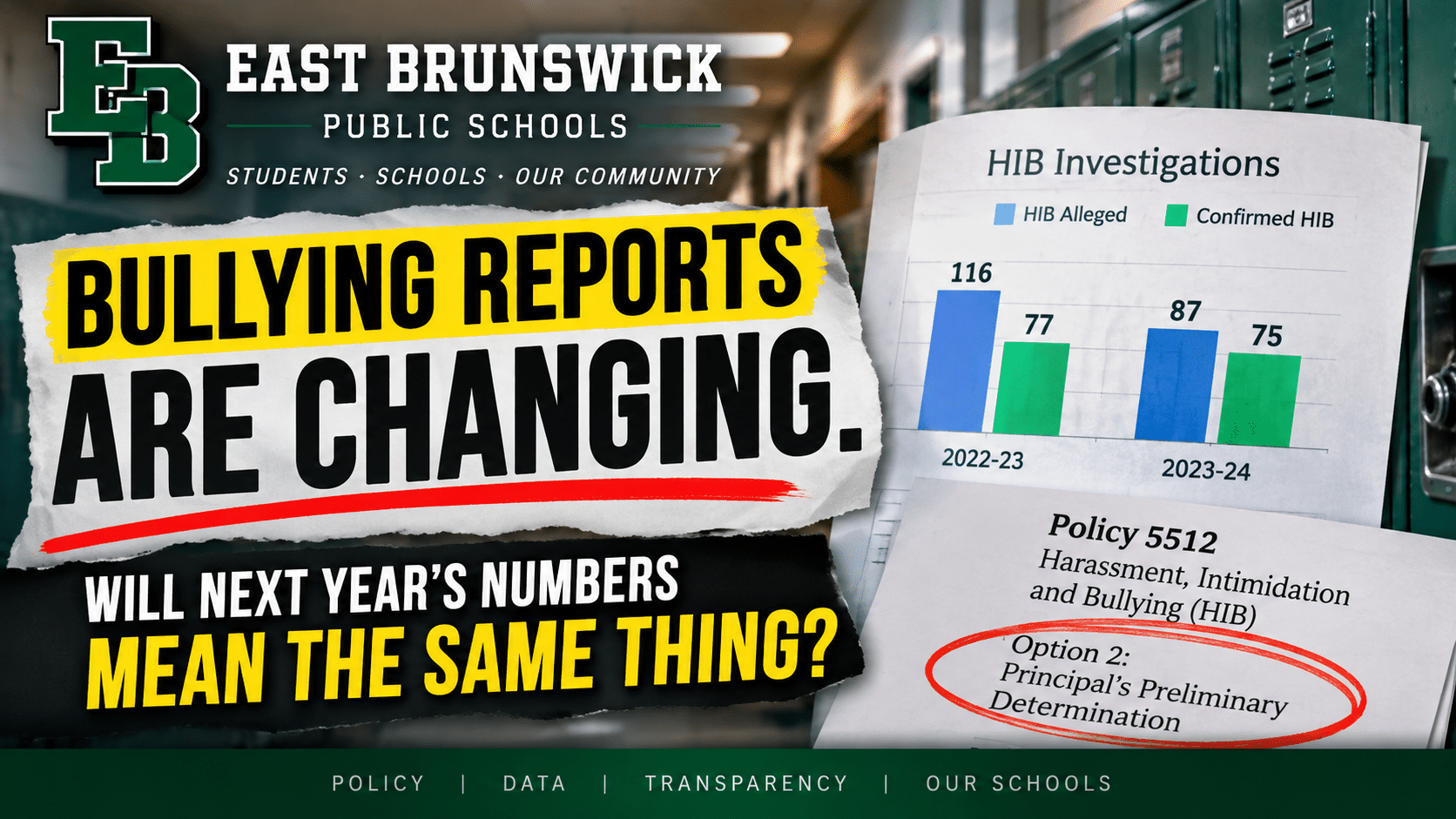
A proposed change in the September 10 Board of Education agenda for tomorrow night’s East Brunswick Board of Education meeting could alter how future harassment, intimidation and bullying statistics are counted and compared.
The item is on for second reading, which means the Board is scheduled to vote, and the agenda states that policies approved on second reading “shall be immediately effective.”
What is actually changing
Policy 5512 governs harassment, intimidation and bullying — HIB, in the shorthand every district uses — and its Section G covers how allegations get investigated.
East Brunswick currently uses what its policy service calls Option 1, “Investigate All Reports.” The adopted policy opens Section G this way: “The Board of Education requires a thorough and complete investigation to be conducted for each report of an alleged incident of harassment, intimidation, or bullying.”
The agenda proposes switching to Option 2, “Principal’s Preliminary Determination.” Under Option 2, before an investigation begins, the principal or a designee — in consultation with the school’s Anti-Bullying Specialist — determines whether the report, “assuming all facts are presented as true,” falls within the legal definition of HIB in state law. If not, the matter is handled under the district’s Code of Student Conduct rather than the formal HIB investigation process.
The distinction matters: a principal is not deciding whether the bullying happened. The principal takes the report at face value and decides whether the conduct described fits the statutory definition of HIB at all. It is a scope decision made before the full investigation, not a finding about the facts.
Several things do not change. A written HIB 338 form must still be completed and still goes to the superintendent, who can overrule the principal and order an investigation anyway. Parents of both students must be given formal notice of the decision. And a parent can appeal a preliminary determination to the Board and then to the state Commissioner of Education — a route that does not exist today, because the decision itself does not exist today.
This is a standard option, not an unusual one
New Jersey has allowed districts to make this choice since a 2022 amendment to the Anti-Bullying Bill of Rights Act. State regulations authorize it, the state’s reporting systems account for it, and Strauss Esmay — the policy service used by East Brunswick and, by its own account, more than 200 other New Jersey districts — offers the two approaches as numbered options.
Eyes on EB checked eleven New Jersey districts’ current adopted HIB policies against their own official policy portals and published documents. Seven already use Option 2; four, including East Brunswick, use Option 1. That is eleven districts out of roughly 600 statewide, not a statewide figure — and there isn’t one. The state collects the answer from every school each year and publishes no tally.
So the point is not that East Brunswick is doing something unusual. Option 2 is a standard choice permitted under New Jersey law and already used by other districts. The issue is whether future HIB charts will still be comparable with the numbers residents have been shown in prior years, when some reports may now be screened out before becoming investigations.
The part that affects the statistics
Reports do not vanish under Option 2. But they stop being counted where the public numbers come from.
The state Department of Education’s guidance for its Student Safety Data System is direct: if a principal makes a preliminary determination that a report falls outside the HIB definition, “it is not referred for an HIB investigation and should not be reported in SSDS.” That matters because both of the state’s HIB categories — “HIB Confirmed” and “HIB Alleged” — describe an allegation “that was investigated by the school.” A report resolved at the preliminary stage was never investigated, so it lands in neither.
The number is not lost altogether. Districts using preliminary determinations must record how many they made in the annual school self-assessment filed with the state, and cannot submit it without them. East Brunswick already publishes that report on its own website, and in the 2024-2025 District and School Grade Report all eleven schools carry this line: “Number of times a preliminary determination was made that an incident or complaint was outside the scope of the definition of HIB: N/A.”
It reads N/A because the current policy does not allow preliminary determinations. If Option 2 is adopted, that N/A becomes a number — but in a separate document, released at a different time of year, reported school by school rather than districtwide. Nothing requires anyone to place it next to the HIB charts the Board actually sees.
What East Brunswick has shown the Board
The slides bound into the district’s December 19, 2024 minutes include one titled “Number of HIB Investigations” and another titled “Number of HIB Investigations – Two-Year Comparison.” Each has exactly two columns: HIB Alleged and Confirmed HIB. Neither shows total reports received, or complaints screened out before investigation — categories that hardly matter under the current policy, because there is no screening step.
The districtwide figures from those charts and presentations: in 2022-23, East Brunswick recorded 193 HIB investigations — 116 alleged and 77 confirmed. In 2023-24, 162 investigations — 87 alleged and 75 confirmed. From January through June 2024, 89 investigations — 47 alleged and 42 confirmed. From September through December 2025, 36 investigations — 22 alleged and 14 confirmed. A full-year 2024-25 total could not be established from available public records.
What the agenda says, and what it doesn’t
The agenda explains the change in one sentence: “The only change is in Section G – Investigation of HIB. We currently have selected Option 1 – Investigate All Reports, and we are looking to adopt Option 2 – Principal’s Preliminary Determination.”
That says what. It does not say why. Eyes on EB did not locate a stated district rationale for selecting Option 2 in the reviewed agenda materials, in the record of the August 20 first reading, or in archived district material. Other policies in the same batch do carry stated reasons. This one was reviewed at the August 18 Policy Committee meeting, a subcommittee that does not meet in public.
Why the comparison matters
East Brunswick has presented these numbers publicly and treated their direction as meaningful. At the September 18, 2025 meeting, then-Superintendent Victor Valeski reported Student Safety Data System and HIB data to the Board, and the minutes record that a resident asked what had been done that caused the decline in HIB incidents. A board member asked that HIB figures be presented as a multi-year trend, and the administration agreed.
If East Brunswick investigated 162 HIB reports in 2023-24 and investigates a smaller number two years from now, a resident reading the chart cannot tell how much of the change is student behavior and how much is the new screening step. The confirmed count should stay comparable, since a report that would ultimately be confirmed has to be within the definition and so should not be screened out. The investigation and alleged counts will not be.
A question the Board could answer
There is a straightforward fix, and it requires the district to collect nothing new. The state already requires districts using preliminary determinations to count those cases in the annual self-assessment. If East Brunswick adopts Option 2, will the district also show that number alongside the HIB charts presented to the Board, so residents can still compare the full picture year to year?
The policy change itself is permitted under state law and already in use elsewhere in New Jersey. The open question for East Brunswick is narrower: whether the district will present the new preliminary-determination count next to its familiar HIB statistics, so parents and residents can tell when the measuring system changed.