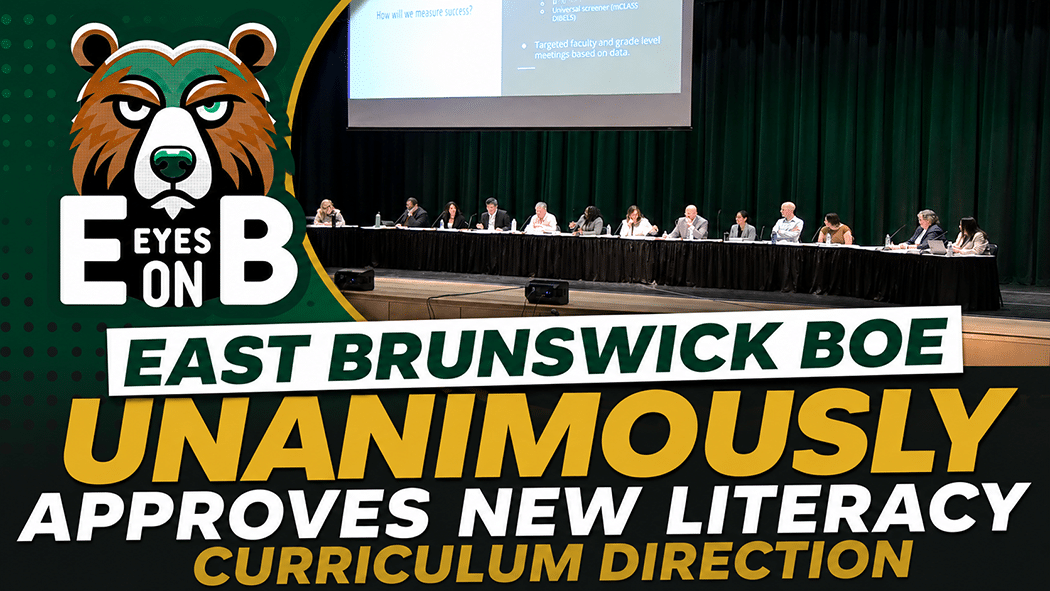
The East Brunswick Board of Education unanimously approved a new ILA (Integrated Language Arts) curriculum direction following a lengthy presentation and discussion that focused on literacy instruction, teacher support, intervention systems, and long term implementation planning.
The presentation, led by Dr. Mamman and district administrators, centered on the adoption of CKLA (Core Knowledge Language Arts) for grades K-2, while also outlining broader literacy improvements planned for grades 3-5. Administrators repeatedly emphasized that the district is not simply buying a curriculum, but trying to build a stronger literacy system around teacher support, intervention strategies, student data, and consistency across schools.
Dr. Mamman opened the discussion by explaining that teaching reading is not solved by one program alone.
“I will still take a highly effective teacher over any one program,” Dr. Mamman said during the presentation.
Pilot Program Helped Shape the Rollout
A major part of the discussion focused on what the district learned from this year’s CKLA pilot program.
According to administrators, teachers who participated in the pilot gave overwhelmingly positive feedback, with Dr. Boley stating that they loved the program and did not want to return to a different one.
The pilot also helped the district identify areas that still need improvement, including pacing, vocabulary instruction, intervention time, and additional support for multilingual learners and special education students.
Current pilot students at Lawrence Brook and Warnsdorfer are expected to be able to continue with CKLA moving forward, with parents also having the option to opt out. Administrators said conversations are ongoing with principals and CKLA representatives regarding additional resources and teacher training needed to support that continuation.
What Changes in K-2
The most immediate change is the formal rollout of CKLA in grades K-2.
Administrators described the early grades as the foundation for literacy development, while also emphasizing the larger goal of helping students move from “learning to read” to “reading to learn” across all subjects.
The district plans to support the rollout with:
- additional literacy coaching
- expanded teacher training
- classroom modeling
- collaborative planning time
- summer professional development
- monthly “Lunch and Learn” collaboration sessions
The district also plans to add an instructional coach specifically focused on supporting the K-2 implementation.
Changes Planned for Grades 3-5
Although CKLA is only being formally adopted for K-2 this year, administrators also discussed significant literacy improvements planned for grades 3-5.
Those changes include:
- additional nonfiction reading
- vocabulary development
- grammar and writing conventions
- structured literacy supports
- deeper language exploration and comprehension work
Administrators said these additions are intended to strengthen gaps they identified in the current literacy structure while creating better alignment moving forward.
Board members also asked questions about what happens as students move into fifth and sixth grade, particularly because scheduling becomes more complicated at Hammarskjold. Administrators acknowledged that more planning discussions are still needed for those grades.
Heavy Focus on Teacher Support
One of the biggest themes throughout the night was teacher support.
Dr. Mamman repeatedly stressed that teachers need more time to collaborate, review student data, learn from each other, and share successful classroom strategies.
“We know that teachers learn best from each other,” Dr. Mamman said. “They need time to come together and learn from each other and share best practices.”
The district said it is increasing PD (Professional Development) opportunities significantly, with training beginning in June and continuing throughout the summer and school year.
Board member Dr. Anna Braun strongly praised the district’s professional development plan, speaking from her own classroom experience and emphasizing that meaningful teacher support is critical during large curriculum changes.
Braun also praised Dr. Mamman’s literacy background and leadership during the process.
Special Education and ESL Supports Also Discussed
The conversation also included extensive discussion surrounding special education and ESL (English as a Second Language) supports.
Administrators said a special education audit is currently underway, while an ESL audit began this week.
The district also discussed MTSS (Multi-Tiered System of Supports) and RTI (Response to Intervention), both systems designed to identify struggling students early and provide targeted academic support.
Administrators explained that the district is looking not only at academics but also at SEL (Social-Emotional Learning), behavior, and intervention strategies as part of the broader literacy plan.
The board also discussed support for students with IEPs (Individualized Education Programs), with administrators emphasizing that teacher collaboration and intervention time will be critical to helping students succeed.
Measuring Success
Administrators said they plan to review student performance every four to six weeks and provide quarterly updates to the board.
The district discussed using student data, classroom walkthroughs, assessments, and teacher feedback to monitor implementation and make adjustments as needed.
The board also discussed a goal of improving literacy benchmark performance by approximately 10 percent over time.
Parent Involvement and Community Feedback
The presentation also highlighted parent involvement through curriculum committee meetings, literacy nights, webinars, and future opportunities for parent and teacher feedback.
Board members noted that parents, staff, administrators, and community members have all participated in curriculum committee discussions throughout the process.
A Long Night and a Major Education Discussion
The meeting ending late, with Teacher Appreciation activities continuing until after 9 PM and the overall meeting ending around midnight.
Notably, no members of the public spoke during the separate budget public comment session. However, several residents did speak during the general public comment regarding a Mandarin teacher who was reportedly retained.
While several board members asked detailed questions throughout the night, the overall direction was clear: the district is moving forward with a broader literacy overhaul that administrators believe will strengthen reading instruction, teacher support, intervention systems, and student outcomes across East Brunswick schools.