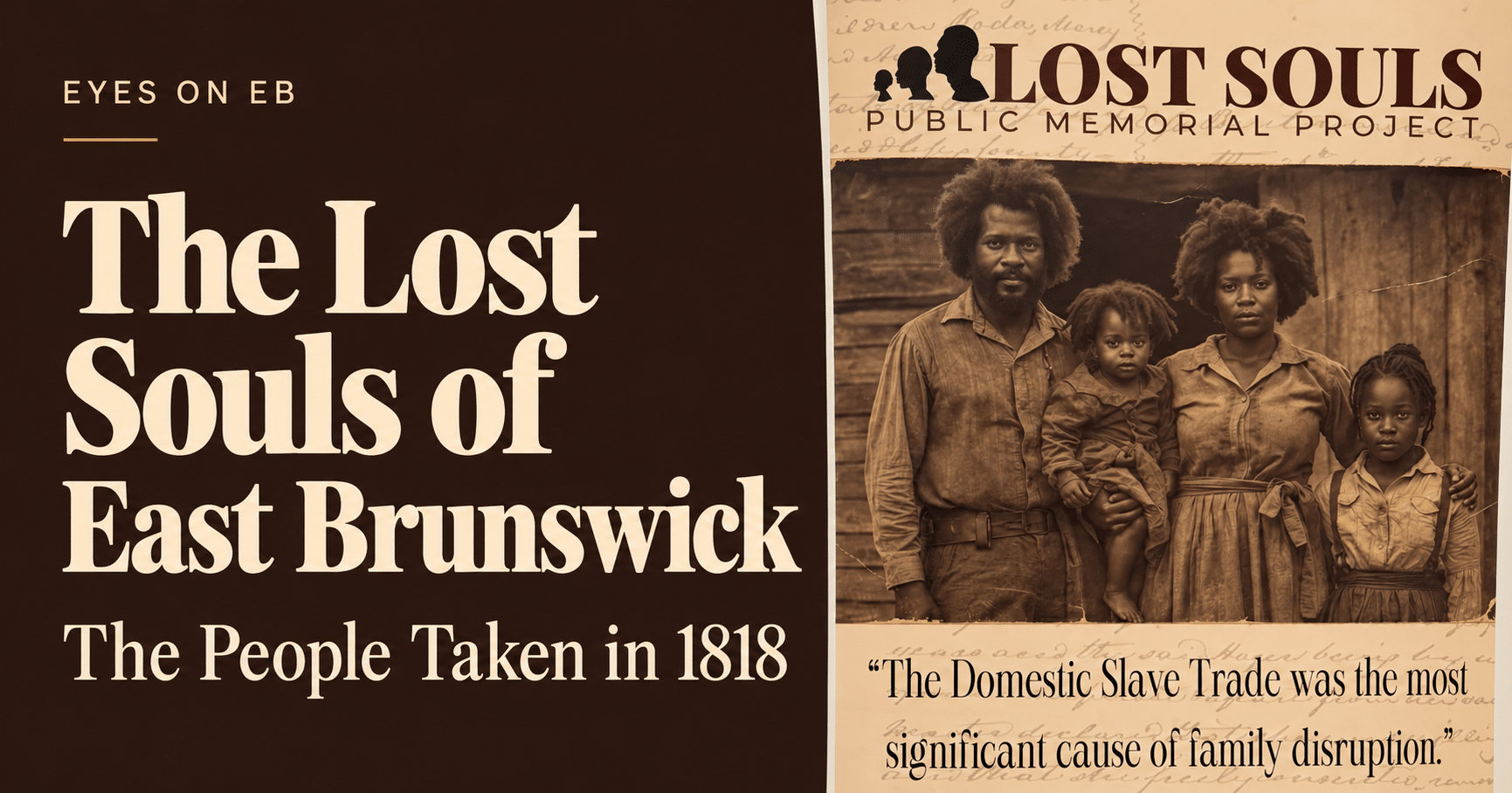
On May 25, 1818, Charles Morgan carried “a certain Negro boy called Joseph of the age of ten days or thereabouts” out of New Jersey from South Amboy, without the consent the law required, a Middlesex County grand jury charged that June. (1818 indictment, NJ State Archives)
The grand jury returned a second indictment over the same child against Mathew Mentor, master of the sloop Thorn, which cleared Perth Amboy for New Orleans that day. (Thorn manifest) Joseph was one of at least 137 people the Lost Souls Public Memorial Project counts as taken south from New Jersey in 1818 by a trafficking ring centered on Jacob Van Wickle, a Middlesex County judge. (Lost Souls Public Memorial Project)
Born free, in law
Under New Jersey’s 1804 gradual abolition law, children born to enslaved mothers after July 4, 1804, were legally free but bound to serve their mother’s owner until age 25 for boys and 21 for girls. The indictments describe Joseph as “a servant for years.”
Historian James J. Gigantino II, in a 2010 article in the journal Pennsylvania History, counted the removals Van Wickle approved in about six months: 60 people enslaved for life and 13 children born under the 1804 law. (Gigantino, Pennsylvania History) Totals differ from the project’s because sources count different groups and documents.
How the ring worked
An 1812 state law allowed an enslaved person to be taken out of New Jersey only if he or she agreed to go in a private examination before two judges. Van Wickle, a judge of the Middlesex County Court of Common Pleas, lived on the South River, at a property Lost Souls researchers place in what is now East Brunswick. (New Jersey Slavery Records)
His son, Nicholas Van Wickle, bought enslaved people in New Jersey as an agent for Charles Morgan, the judge’s brother-in-law, a Louisiana legislator who owned a plantation in Pointe Coupee Parish. People were held at the judge’s property, which newspapers called the “South River Establishment,” before being shipped south, Gigantino wrote.
The removal certificates say each person consented. Gigantino found that 17 of the 60 people enslaved for life whom Van Wickle certified were under 21, too young to consent under the law, and that he certified children as young as six weeks as having “declared their willingness.”
The brig Mary Ann left New York on March 10, 1818, and took on people from New Jersey off Sandy Hook. A passenger later testified that they were hidden below deck when a federal revenue cutter came alongside. In New Orleans, the ship’s captain, William Lee, conceded at trial that his crew had taken at least five people aboard by force. A Louisiana jury acquitted him. Many of those taken were bound for Morgan’s plantation, known as Morganza. (NJ State Library)
Names in the records
The New Jersey Slavery Records database at Rutgers University cautions that the dates, ages and family details in Van Wickle’s certificates may have been falsified. Read side by side, the surviving records still preserve names.
On May 21, 1818, Van Wickle and a second judge, John Outcalt, signed a certificate allowing an enslaved woman named Nancy, recorded as 22, to be taken to Pointe Coupee, Louisiana, “there to serve Colonel Charles Morgan and Nicholas Van Wickle.” The certificate also covered a “male child two days old” but did not record his name. (Nancy certificate, New Jersey Slavery Records) Researchers with the Lost Souls project have identified that infant as Joseph, and the Rutgers database has adopted the identification. (Joseph’s record, New Jersey Slavery Records) No single surviving record names both Joseph and Nancy, and the certificate and the indictments give different ages for the child.
Rachel, recorded as 22, appears on a certificate dated Feb. 26, 1818, with her daughter Rozenah, six weeks old. (Rachel and Rozenah certificate) A June 1818 indictment over the Mary Ann voyage charged Morgan with carrying away “a negro girl called Rozena aged six weeks or thereabouts.” (Rozena indictment, NJ State Archives)
Phillis was recorded on her removal certificate as 25, with a son, Charles, about a year and a half old. (Rutgers Scarlet and Black) The Thorn’s manifest lists “Fillis & childe,” age 28, and a Charles, age 2, and an indictment over the Thorn names a Charles of about two held by Nicholas Van Wickle. Rutgers researchers suggest Phillis’s recorded age was falsified.
Indictments over the Mary Ann name other children: Diana, about seven months; Susan, about seven months; Dorcas, about one year; Mary and Hercules, each about two. (NJ State Archives index)
Jacie L. Bellina, writing for Slavery in Baton Rouge, a public history site, compared names and ages in the 1818 records with an 1848 inventory of Morgan’s estate. (Bellina, Slavery in Baton Rouge) By her reading, a Rachel appears there with a daughter, Isabelle, then 3; a Rosine appears married to a man named Jesse; and a Caroline, about 50, appears married to a man named Burnall. Bellina links that Caroline to one listed on the Thorn. Those are possible matches based on names and ages, not confirmed identifications.
No one convicted
The grand jury indicted Morgan, Nicholas Van Wickle, Mentor and others, mainly over children who could not legally consent. Jacob Van Wickle was not indicted. His name appears as a witness for the state on the indictments over Joseph. No member of the ring was convicted, according to Gigantino and the Rutgers researchers. (Rutgers exhibit)
In October 1818, 103 Middlesex County freeholders petitioned the Legislature to stop the trade, and later that year New Jersey passed a stricter law on taking people out of the state.
A road name, 2017
In 2017, residents asked the Township Council to rename Van Wickle Road.
Local historian Richard Walling helped bring the Van Wickle slave ring into East Brunswick’s public discussion. Council minutes from Aug. 28, 2017 record him speaking about Judge Van Wickle and the slavery ring and asking the township to change the road signs. His advocacy helped put the question of how East Brunswick remembers this history before the council.
On Sept. 25, the Rev. Karen G. Johnston of the Unitarian Society and other residents asked for a new name, and Dr. Evelyn McDowell, president of Sons & Daughters of Slave Ancestry, suggested naming the road for one of the people Van Wickle sold.
Walling continued advocating for the change. On Oct. 9, he read a letter from the president of the New Brunswick NAACP supporting the rename. At that meeting, the township administrator reported inviting the road’s residents to a meeting. On Oct. 23, a resident asked whether the township would consider a memorial.
The minutes record that discussion but no vote, decision or reasoning on the name. Van Wickle Road remains in use today.
Remembering them
The Lost Souls Public Memorial Project began in 2017 and incorporated as a nonprofit in 2020. Its partners include the Unitarian Society and the New Brunswick Area NAACP. The project lists Toni D. Hendrix as president and Kristal C. Langford as vice president and public historian. (Lost Souls organization page)
The project says it has funded historical research in New Jersey and partnered with Louisiana State University’s history department to trace people taken to New Orleans. Langford has given public talks on the victims, including at the East Brunswick Public Library, and the project’s work is featured in “The Price of Silence,” a 2022 NJ PBS documentary about slavery in New Jersey. (NJ PBS) The project also publishes educational materials and says it offers teacher training.
The project holds an annual remembrance at which the names are spoken. The most recent, the 9th Annual Homage to Our Ancestors, was held Oct. 10, 2026, at the New Brunswick Performing Arts Center in New Brunswick. (Lost Souls events page) Mayor Brad Cohen, who attended, described it at the Oct. 12 Township Council meeting as a recitation of the names.
The township has provided a site for a permanent memorial near the entrance to the East Brunswick Community Arts Center on Cranbury Road, which the project’s website says is marked with a temporary sign. Project materials from 2024 and 2025 describe plans for a remembrance garden there. As of Oct. 14, 2026, Eyes on EB found no announced construction start or completion date.
The project says its goals are to connect the people taken in 1818 to the New Jersey communities they came from, to trace their lives in the Deep South and to build a memorial in East Brunswick. Its website lists the names it has documented so far, from infants recorded as days or weeks old to adults in their thirties and forties.