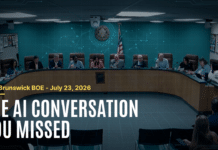
What began as a standard end-of-meeting segment — “For the Good of the Cause” — became one of the most extraordinary evenings the East Brunswick Board of Education has seen in years.
A simple procedural item turned into a raw public conversation about communication, transparency, and leadership. In a town that prides itself on civic engagement, this meeting reminded everyone why transparency is both difficult and necessary.
A Motion Few Saw Coming
After routine votes wrapped up, Board President Dr. Heather Guas invited closing remarks. Instead, Dr. Jaime Falco asked for the floor.
“Madam President, I move to discuss a vote of no confidence in board leadership.”
The room quieted. Even seasoned observers were surprised — votes of no confidence are rare in local boards and, while symbolic, they speak volumes.
Dr. Falco explained her reasoning plainly:
“It’s come to this board’s attention that there have been difficulties in communication and transparency. Those of us who sit up here are of equal standing. When business is conducted on our behalf and without our knowledge or consent, we believe that, according to Roberts Rules, we have the right to discuss a vote of no confidence.”
Her concern stemmed from an email that had gone out to every family in the district announcing the selection of a new superintendent — an email signed solely by President Guas and labeled “on behalf of the Board.” Several members said they had neither seen nor approved the message before it was sent.
Dr. Figueroa quickly seconded the motion.
Dr. Tanious stated that she echoed the frustration that many in the community have voiced for months.
“I received that email as a parent,” she said. “It was disheartening to receive that when I am an appointed official. We are a board of nine. The president of the board is the first among equals. It does not give you the authority to act on behalf of the board without consent of the board.”
Dr. Tanious emphasized that this wasn’t personal:
“This has nothing to do with Dr. Valeski or any administrator. This is about leadership. Respectfully, Madam President, don’t call me a liar. Everyone here knows the email delays we’ve experienced.”
The exchange, firm but civil, crystallized a long-standing tension: how information flows from administration to the board, and from the board to the community.
“Nothing to Report”
President Guas defended her record, pointing to the sheer volume of correspondence she receives.
“The emails from this board are substantial,” she said. “I read them all. I’ve tried to be more responsive, and I will send weekly updates if that’s what the board wants — even if the update simply says, ‘I have nothing to report.’ ”
That remark drew a pointed response from Dr. Tanious:
“There should be something to report. You’ve said you speak with Dr. Valeski daily. How is it possible that there’s nothing to report from those conversations?”
Her comment resonated beyond the dais. For months, parents and teachers have questioned why major developments — from budget presentations to administrative hires — seem to reach social media before they reach the board itself.
Dr. Pan: “We Lost the Pattern of Communication”
When Dr. Wilbur Pan spoke, the conversation shifted from accusation to analysis.
“From my point of view, there’s been a consistent pattern of limited communication that could have been more frequent, more regular,” he said. “During the superintendent search, communication was highly successful. Afterward, that pattern went away.”
He described learning about district matters indirectly — from community events or online posts — rather than through structured board updates.
“It would have been nice for us to know that such meetings were happening. Even a simple ‘things are in process’ would go a long way.”
Dr. Pan stressed that his comments were not political.
“This is not about the election. No one should weaponize this. It’s about leadership, not membership.”
Later, as the discussion wound down, he added somberly:
“Given the tenor of this conversation, it seems clear that the root cause lies in communication from leadership. Our number-one priority should be the students, and that means ensuring a seamless transition for our new superintendent.”
His remarks — calm, methodical, but unmistakably disappointed — drew nods from several colleagues and from many in the audience.
Dr. Falco: “Equal Standing Means Equal Information”
Returning to the floor, Dr. Falco clarified the intent behind the motion.
“A vote of no confidence is not a censure. It’s a declarative statement that we are dissatisfied with the way communication is being handled.”
She cited repeated unanswered emails, inconsistent updates, and confusion over who could speak publicly on behalf of the board.
“Equal standing means equal information. If board members are finding out about district actions as parents, not as officials, something is broken.”
To longtime observers of East Brunswick meetings, her comments reflected a theme that has surfaced all year — questions about process and chain of communication rather than ideology.
Tim Cummings: “We Need a Plan”
When Tim Cummings spoke, the temperature in the room lowered. His remarks were measured but candid.
“Things don’t always work out the way we intend,” he said to Liwu Hong, who had just offered an emotional apology for his own misstep involving an unapproved dinner invitation between the incoming superintendent and the mayor. “I respect and appreciate that your intention was pure.”
Turning to the broader issue, Cummings continued:
“Leadership in any organization is complex. I don’t envy the role of president. But we need a plan. We can’t move anywhere without one. Right now everybody’s confused, everybody’s frustrated, and that doesn’t work. Let’s focus on building a plan that gets everyone rowing in the same direction.”
He also underscored the urgency of preparing for the superintendent transition.
“We still don’t have a plan, and that’s not fair to her — or to us. We’re in the midst of the most massive transition this district has seen, and we need leadership that can pull all of these bright minds together.”
Many in the audience later described Cummings’ remarks as the night’s “reset moment,” steering the conversation from blame to solutions.
Liwu Hong
“My Intention Was to Help, Not to Hurt”
In one of the night’s most emotional moments, Liwu Hong stood to clarify his role in what he described as a misunderstanding that had spiraled into mistrust.
“I NEVER LIE,” HE SAID, VISIBLY SHAKEN. “MY INTENTION WAS TO HELP, NOT TO HURT. IF THE PUBLIC BELIEVES I MADE A MISTAKE, I APOLOGIZE FROM MY HEART.”
Hong explained that his decision to invite the incoming superintendent and the mayor to dinner was made with good intentions — to build bridges, not to bypass protocol.
“I ALWAYS TRY TO HELP THE COMMUNITY,” HE SAID. “IF PEOPLE THINK I MADE A MISTAKE, I’LL TAKE THE BLOW.”
His remarks momentarily shifted the tone of the meeting, underscoring how personal actions and missteps can quickly become part of larger questions about communication and accountability.
Dr. Braun: “I Hate Surprises”
Dr. Anna Braun, though brief, spoke for many when she said:
“I hate surprises. Don’t give me a surprise party. I want to know things ahead of time. This has been an ongoing issue — we shouldn’t be learning about presentations or proposals on Facebook the next day.”
She recalled discovering a major facilities presentation only after community members contacted her. “That’s not good. That’s inappropriate,” she said simply.
Her words distilled what parents, teachers, and even some administrators have expressed privately: that governance by surprise undermines trust.
Dr. Tanious: “Equal Authority Means Shared Information”
As the conversation circled back to Dr. Tanious, she doubled down on the principle of equality among board members.
“We are a board of nine, and we have equal authority,” she said. “If you’re getting so many emails from so many board members, that should be a very telling sign that there is a communication failure somewhere.”
She rejected the notion that her persistence was bothersome.
“I like to make informed decisions. When I rephrase questions, it’s because I didn’t get an answer. That’s not pestering — that’s governing.”
Her composure through the exchange drew quiet support from residents who later praised her for “speaking the frustration many of us feel when information is withheld.”
An Uncomfortable but Honest Vote
After nearly an hour of discussion, the board’s attorney reminded members that a vote of no confidence carries no legal consequence; it is a public expression of sentiment.
When the roll call came, seven voted “yes,” one abstained, and President Guas voted “no.” The motion passed 7-1-1.
There was no applause, no visible celebration — only a subdued silence that conveyed how difficult the decision had been.
Even Dr. Pan, who had earlier considered a follow-up motion, clarified that his comments were “not meant for entertainment” but for the sake of “moving the district forward.”
The Communication Deficit
This meeting laid those grievances bare, with nearly every board member acknowledging that something fundamental had gone wrong in how information travels inside the district.
Tim Cummings called it a “deficit”—a gap that leaves the board rowing in different directions. “We can’t move anywhere without a plan,” he said. “Everybody’s confused, everybody’s frustrated, and that doesn’t work.”
Dr. Anna Braun called the breakdown “inappropriate,” saying board members shouldn’t be blindsided by events or find out about district matters through Facebook. “I hate surprises,” she said flatly. “I want to know things ahead of time.”
Dr. Jaime Falco described the situation as “a pattern” of limited transparency that erodes the equality of the board. “Equal standing means equal information,” she said. “If we’re learning about decisions as parents instead of as board members, something is broken.”
Dr. Wilbur Pan compared it to “a blank wall of information.” “During the superintendent search, communication was highly successful,” he said. “Afterward, that pattern went away. Even a simple, ‘things are in process’ would have gone a long way.”
Dr. Marianne Tanious called it “a failure somewhere along the line.” She noted that a high volume of board emails should signal a systemic issue, not an inconvenience. “If you’re getting that many messages, that tells you there’s a problem with the process, not with the people asking questions.”
Laurie Herrick spoke to the emotional toll of that vacuum, saying the disconnect “creates fractions and silos.” She said, “We shouldn’t have to find out that other people know more than we do. It makes us feel like we’re working in the dark. We all want to be at the same table.” Herrick urged the board to adopt a clearer communication plan and more frequent meetings: “Meeting once a month isn’t setting us up for success.”
Dr. Louis Figueroa—who ultimately voted yes on the motion—kept his remarks brief but echoed the theme of imbalance, saying that leadership works only when “everyone feels informed and respected.”
Even President Heather Guas acknowledged the strain. She described her inbox as “197 pages of emails” and admitted, “It’s a tricky path. This has been both an excellent and a rough experience.”
Liwu Hong called the situation “a misunderstanding that turned into mistrust.” He said, “I NEVER LIE. MY INTENTION WAS TO HELP, NOT TO HURT.” Hong explained that his actions were meant to strengthen relationships within the community, not to cause confusion. “I ALWAYS TRY TO HELP THE COMMUNITY,” he said. “IF PEOPLE THINK I MADE A MISTAKE, I’LL TAKE THE BLOW.” His comments added a personal dimension to a broader discussion about communication and accountability.
A Community That Still Values Transparency
If there was any silver lining, it was that this conversation happened in the open. No closed session. No back-room debate. Just an uncomfortable but necessary airing of concerns in front of the public that elected them.
Residents have been asking for precisely that — honesty, even when it’s messy.
“You can’t fix what you won’t talk about,” one parent said afterward. “At least now they’re talking about it.”
In a township where political temperatures have run high, moments like this suggest a deeper civic maturity: disagreement without abandonment of civility, critique without contempt.
Looking Ahead
With the election weeks away and a new superintendent preparing to take office, the board’s ability to rebuild trust will shape East Brunswick’s next chapter.
Dr. Falco summarized that challenge best:
“This isn’t meant to embarrass anyone. It’s about ensuring that Dr. Mamman is set up for success.”
Cummings agreed:
“Our number-one priority is the students. For them to thrive, we need clear communication and unified direction.”
In the end, that is what the community wants — a board that models the transparency it expects from others.
For now, residents can only hope that for the good of the cause was more than just a meeting segment — that it marked the start of a genuine commitment to clarity, collaboration, and trust.