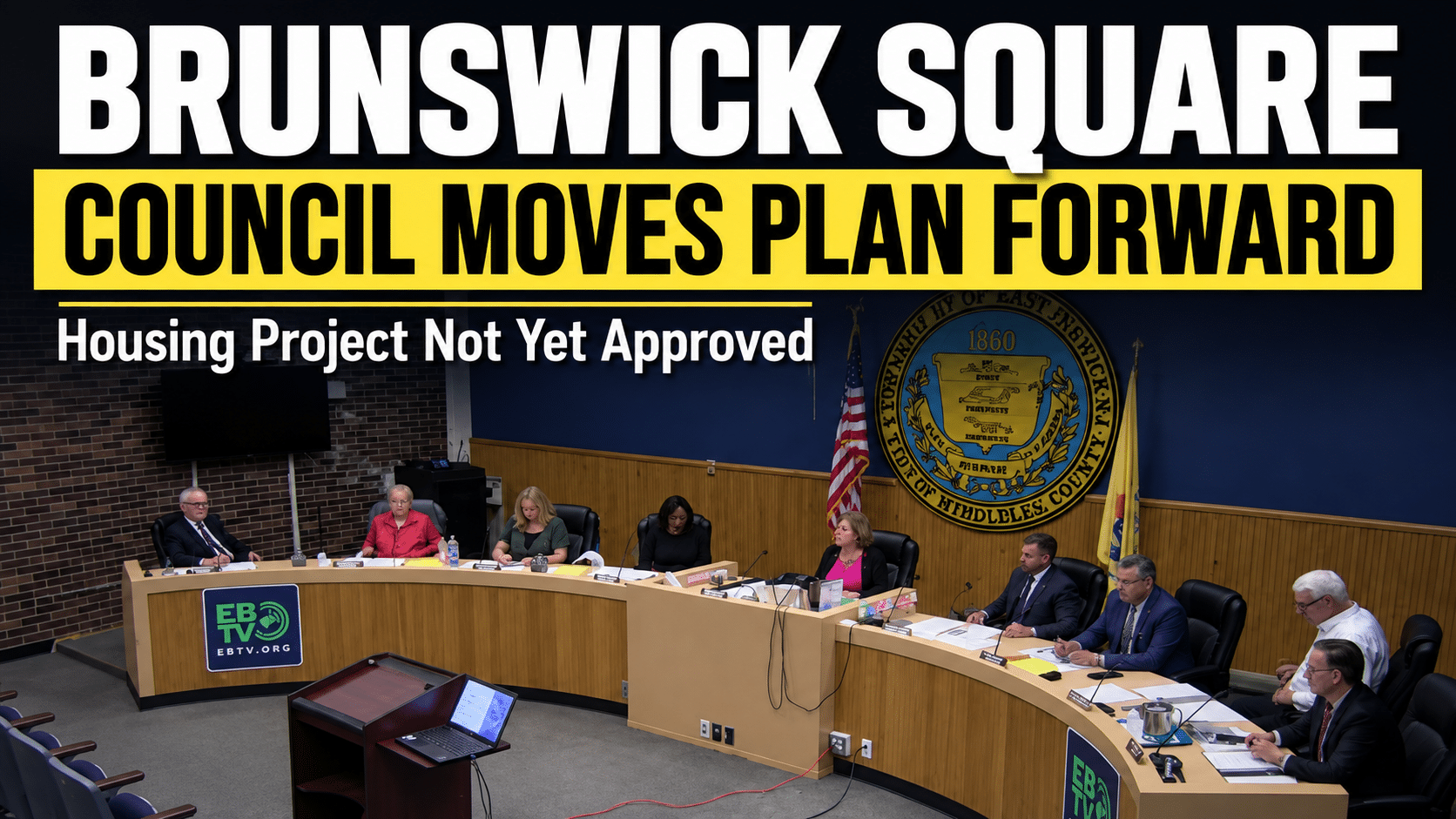
The Council introduced the redevelopment plan and sent it to the Planning Board on Sept. 14. Officials stressed that 250 units is a zoning maximum, the site layout is conceptual, and there is no designated redeveloper, no redevelopment agreement and no PILOT.
East Brunswick’s Township Council voted Monday night to move the Brunswick Square redevelopment plan forward. It did not approve a housing development.
That distinction came up repeatedly during the nearly three-hour Sept. 14 meeting, as more than a dozen residents asked about traffic, schools, taxes and what the township was actually approving.
“What we’re doing tonight is basically approving a zoning ordinance,” Councilman James Wendell told one resident.
Our earlier story laid out what the plan would allow: up to 250 residential units, four-story buildings and a new traffic signal on Rues Lane. This one covers what happened Monday, what officials clarified and what comes next.
What the Council actually did
The Council took two votes on the plan. Both passed 5-0.
- Resolution 26-282 sends the plan to the Planning Board for review. It was pulled from the consent agenda and voted on separately.
- Ordinance 26-25, which would adopt the plan, was introduced. That is a first reading, not final adoption.
The public hearing and final vote are scheduled for Sept. 28.
What “250 units” means at this stage
The plan sets a ceiling, not a building count.
“We have not approved anything,” Kate Keller, the planner who presented the plan, told a resident who asked. The township is “putting zoning in place that would permit a maximum of 250 residential units,” she said, with 20% set aside as affordable.
Asked how the township could approve 250 homes without knowing their tax impact, Wendell said a developer or property owner could come in and say, “I want to build 150 units.”
Keller repeatedly called the site layout she showed conceptual. “This is very conceptual,” she said; it does not fix building footprints. The concept shows the Macy’s store demolished and replaced with new retail, with one residential building toward the rear. Details such as the traffic signal, Keller said, would be settled later with the county and state and in a redevelopment agreement.
No PILOT has been approved
One resident asked directly whether a PILOT deal had been reached for Brunswick Square.
“There is no pilot,” an official answered. Mayor Brad Cohen said the financial plan “hasn’t even been discussed because we don’t know what they’re building.”
Without a project, Cohen said, there is no way to assess its value or whether it would even qualify for a PILOT. “It’s way too early in the process,” he said.
Later, Township Attorney Anthony Iacocca laid out the order of events. After the plan is adopted, a developer can present a project to the Redevelopment Agency in public, and negotiations over amenities and contributions happen there. Only after the agency approves a developer and a redevelopment agreement, he said, can the parties “talk about financial agreements.”
“We’re at the very beginning,” Iacocca said. “It’s not a project.”
The ordinance and draft plan in the Council’s agenda packet contain no PILOT, financial agreement or tax exemption.
Why the Sept. 30 deadline matters
Before the presentation, Iacocca said a recent court order governing East Brunswick’s Fourth Round affordable-housing compliance requires the township to adopt a redevelopment plan for Brunswick Square by Sept. 30, 2026. He said meeting the deadline lets the township keep “local planning control” and avoid the risks and possible penalties of noncompliance.
Cohen said the rest of the township’s Fourth Round plan was settled in February, but the mall site got an extension to the end of September because it had no redevelopment plan. Keller had told the Planning Board in February that the township had an “extension through September” for the mall.
Cohen said that without the affordable-housing obligation on this site, “we would not be rushing to get this done” by the end of the month.
Those are the township’s descriptions. Eyes on EB has not reviewed the court order, which was not in the Council’s meeting packet.
The Sept. 28 hearing falls two days before that deadline, and the Planning Board review must come first.
What residents raised
Several speakers said they wanted to see the mall succeed. Their questions and concerns fell into five areas:
- Traffic. Neighbors near Rues Lane, Summerhill Road and Hillsdale Road asked about added traffic and the 55-foot height limit. Officials called the proposed signal at Hillsdale Road and Rues Lane preliminary. A question about whether anyone has studied cumulative Route 18 traffic was not answered at the meeting.
- Schools. Several speakers asked how new housing would affect schools. Cohen later said district enrollment has been roughly stable for years.
- PILOTs. Two speakers argued PILOTs take money from the school district, and one urged revenue sharing with the Board of Education. Cohen disputed that schools are shortchanged. He said the township cannot legally use PILOT money for ongoing school costs.
- Cumulative development. Speakers cited Vermella, Legacy Place and other projects. Business Administrator Joseph Criscuolo said water and sewer capacity is sufficient, and Wendell said developers must obtain “will serve” letters from utilities.
- Communication. Several speakers said they learned about the plan mostly from social media. Cohen said the township has held town halls for years, and that there would be “every attempt” to involve residents as details are filled in.
What happens next
Officials described these remaining steps:
- Planning Board review of whether the plan is consistent with the township’s master plan.
- Council second reading, public hearing and final vote, scheduled for Sept. 28.
- A developer presents a project to the Redevelopment Agency.
- Designation of a redeveloper. None has been named.
- Negotiation of a redevelopment agreement. The draft plan requires a signed agreement before the Planning Board can hear a development application.
- A possible financial agreement, such as a PILOT.
- Site-plan approval from the Planning Board. Keller said nothing can be built without “full preliminary and final major site plan approval.”
Cohen said there is “no real timeline” for the Macy’s phase, and Keller said the phases need not be built in order.
What about the rest of the mall?
The plan covers the central mall, the Macy’s property, the Olive Garden parcel and a small retail building on Route 18. JCPenney and several neighboring lots are not included.
Asked whether later phases would add housing, officials said they don’t yet know what a future phase would look like. Keller said the plan could be amended, or a new one adopted, to cover more of the mall, and noted that JCPenney is open and wants to stay.
On the JCPenney side specifically, Keller said the township’s current housing plan calls for no more homes. She said she believed that plan identifies 250 to 300 units for the property, and that the new plan caps it at 250 because “we believe we can meet those other 50 units elsewhere in the township.” A February 2026 version of the housing plan reviewed by Eyes on EB lists the mall site at a “minimum of 300” units.
“In order to meet the housing obligation, we don’t need to put any housing over there,” Keller said. That doesn’t rule out housing in a future phase. It means the current plan doesn’t require it.
Bottom line
Monday’s votes advanced zoning rules, not a construction project. There is no designated redeveloper, no redevelopment agreement and no PILOT, and the layout is a concept. The Sept. 28 public hearing is residents’ next chance to speak before the final vote.